Subscribe now for full access and no adverts
In the previous few columns I have explored some of the great towns of Roman Britain – so, as a change of pace, here I will begin a new mini-series on the country’s great prehistoric sites. I will commence this month with a series of locations in Norfolk and Suffolk where there is evidence for Palaeolithic activity, some dating back to the Lower Palaeolithic (c.3.3 million-300,000 years ago), others spanning the Middle and Upper Palaeolithic (c.300,000-50,000 and c.50,000-12,000 years ago, respectively). This is far outside the research timespan of most archaeologists, and involves partnership with a host of disciplines in the earth sciences: it can feel like distinctly unfamiliar territory. To help explain these sites and finds, Current Archaeology has produced regular updates on the wider research landscape. A crucial starting point is CA 190 (February 2004), which introduced the Ancient Human Occupation of Britain (AHOB) project of 2001-2011. CA 210 (July 2007) followed up on this after the publication of Chris Stringer’s book Homo Britannicus, which remains the best general introduction to this subject; meanwhile, CA 330 (September 2017) and CA 331 (October 2017) featured Nick Ashton’s book Early Humans, providing a deep dive into the Palaeolithic and the Mesolithic. Most recently, CA 372 (March 2021) introduced the latest key book on the topic: Rebecca Wragg-Sykes’ Kindred: Neanderthal Life, Love, Death, and Art.
Adventures in Deep Time
Focusing on Suffolk and Norfolk, the two most important sites are Pakefield in the former and Happisburgh in the latter – both on the coast, where cycles of erosion regularly expose new materials. CA 201 (January 2006) first examined these sites at the time of what remains one of the greatest finds in the history of British archaeology: a handaxe discovered in situ in coastal muds by a man walking his dog along the beach in 2000. He was a keen collector of fossils and minerals and spotted the axe at extreme low tide; he reported it to Cromer Museum, who then reported it to Norwich Museum, who in turn reported it to the British Museum. Fieldwork to follow up the find securely dated the thick peaty deposit within which it was discovered to around 700,000 years ago. In a flash, this single artefact had shown that humans were present in what became Britain 200,000 years earlier than had previously been known. Remember to keep a similarly sharp eye out on your next coastal walk!

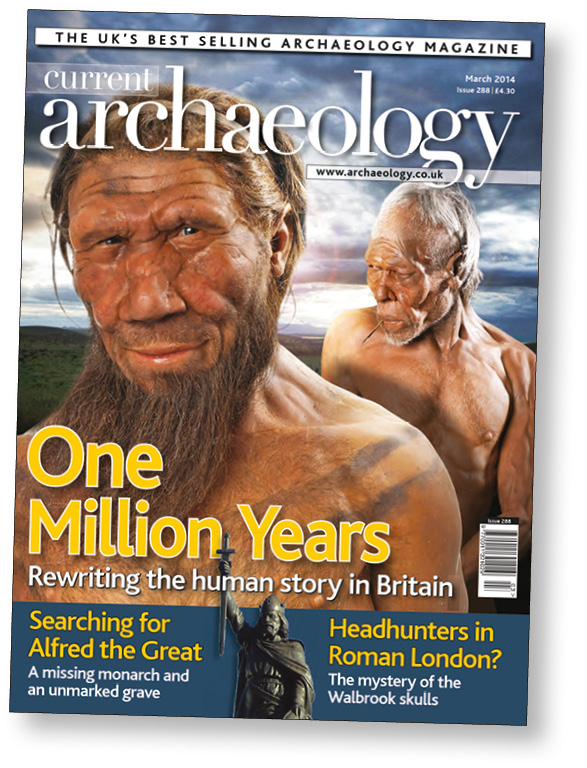
CA 201 outlined the history of the discovery, as well as the wider chronology and context of both Happisburgh and Pakefield, and the magazine revisited the former site, reporting on additional fieldwork, in CA 246 (September 2010). In total, more than 70 flint tools and flakes were eventually unearthed along the Happisburgh foreshore. CA 288 (March 2014) then returned to both locations in a multi-site review linked to the Natural History Museum exhibition One Million Years of the Human Story that was on display at that time. By this point, six Palaeolithic sites had been identified at Happisburgh, including the oldest archaeological site in northern Europe (Site 3, approximately 900,000 years old, notable for its excellent organic preservation) and what may be the world’s oldest underwater archaeological site. CA 288 also dug into the details of Pakefield, located 20 miles south of Happisburgh in neighbouring Suffolk and long suspected to be a likely source of Palaeolithic finds. Fieldwork in the early 2000s proved these suspicions right, with more than 30 worked flints identified, including a flaked core and debitage from tool-making, all from clearly stratified deposits containing fossil plants and animals, which helped to securely date the site to at least 700,000 years ago.
CA’s most recent visit to both sites came in April 2014 (issue 289), with yet another remarkable find: the earliest known human footprints in Europe, just to the south of the main site at Happisburgh. They were discovered, preserved in the mud, in May 2013 in a newly uncovered sediment layer of the low-tide foreshore, and research subsequently identified them as the oldest known hominin footprints outside Africa, dating to around 850,000 950,000 years ago. Cumulatively, the discoveries made at Happisburgh and Pakefield during the early 2000s transformed our understanding of not just British but global prehistory, shifting back dates for the earliest human occupation in this area, and triggering questions about relative chronologies and human abilities in the deep past. These were extraordinary finds made under extraordinary circumstances.
The Curious Case of the Norfolk Elephants
Fifteen miles further north along the Norfolk coast from Happisburgh lies West Runton, between Sheringham and Cromer. CA 149 (September 1996) outlined what happened after two locals walking along the beach there in 1990 discovered what looked like a large bone sticking out of the cliff face, and CA 201 (January 2006) returned with wider context. The find turned out to be the pelvic bone of a large steppe mammoth, and a year later a local fossil hunter discovered more bones nearby, triggering a full excavation. This unearthed 85% of one elephant, representing the most complete set of bones of a steppe mammoth yet unearthed in the world, encased within a freshwater ‘bed’ – a five-foot thick layer of mud deposited by a river 600,000-700,000 years ago.
A related set of finds were then made under very different circumstances at Lynford Quarry, near Thetford in Norfolk (in a twist of fate, the site lies midway between Neolithic Grime’s Graves and the find-spot of the famous West Tofts Acheulean handaxe). CA 182 (November 2002) outlined the site’s discovery and excavation, and CA 205 (September 2006) returned with a wider discussion of its significance (see also CA 232, July 2009, for the context of the site in the wider story of human evolution). Work there eventually showed it to be a well-preserved Neanderthal hunting/butchery site of the Middle Palaeolithic, dating to approximately 60,000 years ago and including in situ the remains of at least nine woolly mammoths associated with stone tools and debitage, with the artefactual and environmental evidence all neatly sealed within a palaeochannel.