Subscribe now for full access and no adverts
By the end of World War II, the United States possessed the world’s largest and best-equipped air force, which made a critical contribution to the Allied victory. American airpower was based on the support of an unrivalled industrial base and on remarkable technological progress, culminating in the production of atomic bombs, delivered by state-of-the-art B-29 Superfortresses in August 1945. The words popularly attributed to Japan’s Admiral Yamamoto, that his country’s attack on Pearl Harbor had awakened a ‘sleeping giant’, seemed to have come true.
In the early stages of the Cold War, the air force took centre stage as the body that would, in the last resort, have been called on to spearhead a nuclear assault on Soviet Russia. A network of forward bases was established around the world to make this possible. By the 1950s, jet bombers, spy planes, and long-range missiles were set to transform the environment in which military planners operated. Proxy wars in Korea and Vietnam tested American air- power on the battlefield, while successive US administrations engaged in a prolonged arms race with the USSR (see MHM 152, June/July 2026).
The path to aerial dominance had, however, been an uneven one. Although the world’s first powered flight in December 1903 was an American engineering achievement, the US was slower than its European rivals to apply the new technology to military purposes. During World War I, the US relied heavily on aircraft manufactured by its allies. In the immediate aftermath of both world wars, cost-cutting led to rapid demobilisation of aircraft and personnel. Advocates of airpower struggled to make their case to politicians and the wider public, whose peacetime priorities lay elsewhere.
It took the emergence of alarming external threats – first Nazi Germany and imperial Japan, then the Soviet Union – to secure domestic support for the expansion of air-fighting capacity. The US air-arm did not gain complete institutional independence from the army until 1947 – almost 30 years after the UK had formed a separate RAF. Even then, there was never an unchallenged consensus within the US defence establishment about the use that should be made of this new power.
In our special for this issue, we examine in depth America’s emergence as a global airborne superpower. In the first of our two articles, Graham Goodlad analyses the factors that at different times promoted and delayed the development of the US air force between World War I and the Cold War; while in our second article he focuses on the hardware deployed by American forces across a period which saw fragile wooden biplanes superseded first by larger piston-engined monoplane fighters and bombers, and then by jet-powered aircraft.
The rise of US airpower
On the eve of World War I, few observers can have envisaged the enormous mid-century growth of American airpower. The organisation founded in August 1907 as the US Army Signal Corps Aeronautical Division did not gain fully independent status for another four decades. It underwent a bewildering number of name changes before taking final form as the US Air Force (USAF) in September 1947. Up to then, it remained formally part of the US Army.
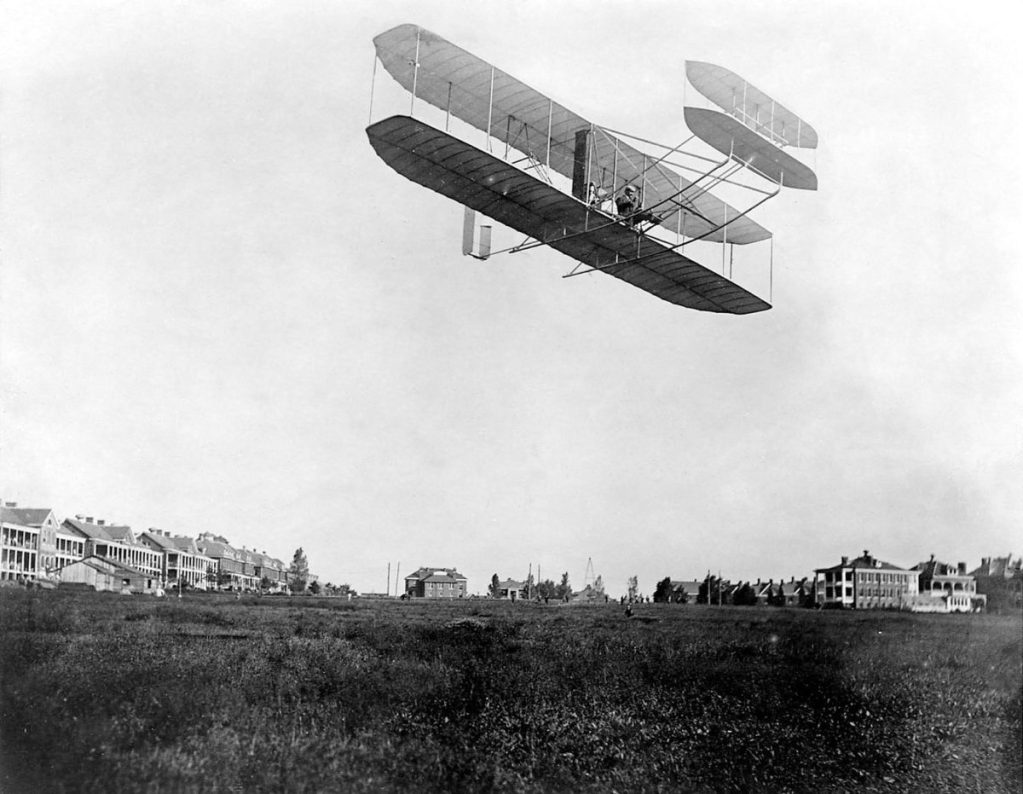
The fledgling Aeronautical Division acquired its first aircraft, a wood-and-wire construction Wright Flyer, in 1908. It was an inauspicious beginning. The world’s first fatal air crash occurred in September when the fragile craft, piloted by Orville Wright himself, suffered a cracked propeller. This severed a wire, causing the plane to drop from a height of 125 feet, taking the life of the passenger, Lieutenant Thomas Selfridge.
In July 1914, as Europe descended into war, the renamed Aviation Section possessed just 23 aircraft. It was authorised to recruit just over 300 personnel – to put this in context, the US Army at the time comprised some 98,500 officers and men. Reflecting the very real risks of flying at the time, initially only unmarried lieutenants under 30 were allowed to join – a requirement which necessarily limited pilot retention and the overall development of the service.
The outbreak of war pushed the US government hesitantly towards the expansion of its aviation capacity. The 1916 National Defense Act allocated $13 million to the service, a significant increase on earlier sums. However, when President Woodrow Wilson reluctantly took the US into war the following year, the Aviation Section had fewer than 250 aircraft and no coherent thinking had been done about how to use them. No American observers had visited the European battlefields, and knowledge of technical advances was woefully lacking. Apart from a small number of US personnel who took part in a brief and inconclusive expedition to Mexico in 1916, none had operational experience.
Despite further increases in spending, and an intensive if belated ramping up of industrial production, the US remained dependent on its French and British allies for airframes and engines. Only 1,200 American-built aircraft actually reached the Western Front during the 19 months of US participation in WWI. The need to make up gaps in the training of pilots and technicians meant that American planes did not actually fly in combat until April 1918.
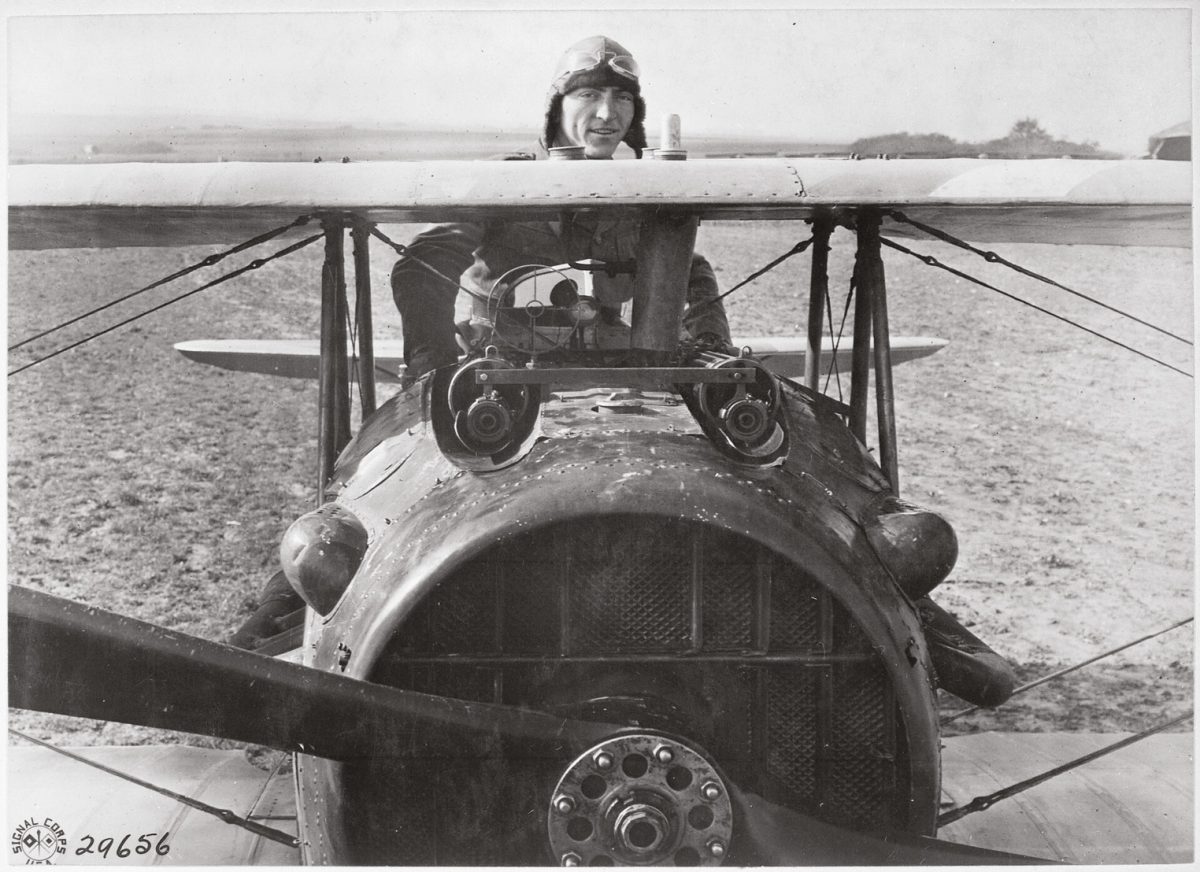
Although brief, the US contribution demonstrated promise for the future. The first American aces, Eddie Rickenbacker with 26 kills and Frank Luke with 18, made their mark. General John Pershing, commander of the American expeditionary forces, refused to have his air-arm integrated with the French and British contingents. He retained overall control in the St-Mihiel offensive in September 1918, in which almost 1,500 allied aircraft took part. Their role was to support a ground operation, aimed at winning control of a strategically important salient in north-east France.
Massed formations of aircraft took part shortly afterwards in the Meuse-Argonne offensive, protecting allied ground forces and attacking a German troop build-up. There was still some way to go in developing effective tactics, but a new air fighting force had been forged from uncertain beginnings in a short space of time. The years 1917-1918 had also seen the emergence of a new breed of air leaders, who would play a critical role in subsequent decades.
New directions
The most controversial representative of the upcoming generation was Billy Mitchell, a soldier who had served in America’s imperial wars in Cuba and the Philippines before becoming the youngest officer on the General Staff. Transferring to the air-arm, he had been given operational command of all US units in France by the autumn of 1918. Post-war, he evolved into an outspoken advocate of a new departure for the force which, in yet another name change, was now known as the US Army Air Service.
For the first time, it seemed possible that America might be threatened from the air.
Mitchell believed passionately in two related ideas: that there should be an independent air force, and that its resources should be focused on building up a strategic bombing capability. As Assistant Chief of the Air Staff in 1920-1925, he argued that the concentrated use of overwhelming force was the surest way to win a war. Air units must gain control of the air space and then attack vital centres of production, communications, and troops on the move. It was Mitchell’s misfortune to be making his case at a time when Congress and public opinion were swinging in favour of military budget cuts, and moral abhorrence for bombing was growing.
With a unique gift for picking quarrels, Mitchell also claimed that airpower could replace the Navy as the front line of national defence. To make his point, in July 1921 he organised a demonstration in Chesapeake Bay, using twin-engined Martin NBS-1 biplane bombers to sink a captured German battleship, the Ostfriesland, in front of the nation’s press. He repeated the trick with several other ageing vessels. Mitchell and his naval opponents drew diametrically opposed conclusions from these theatrical displays. To the air commander and his acolytes, it was proof that warships were obsolete. His critics, on the other hand, pointed out that the exercises had not replicated the reality of war at sea: the ships were disarmed and at anchor, rather than presenting moving targets with a capacity to hit back.
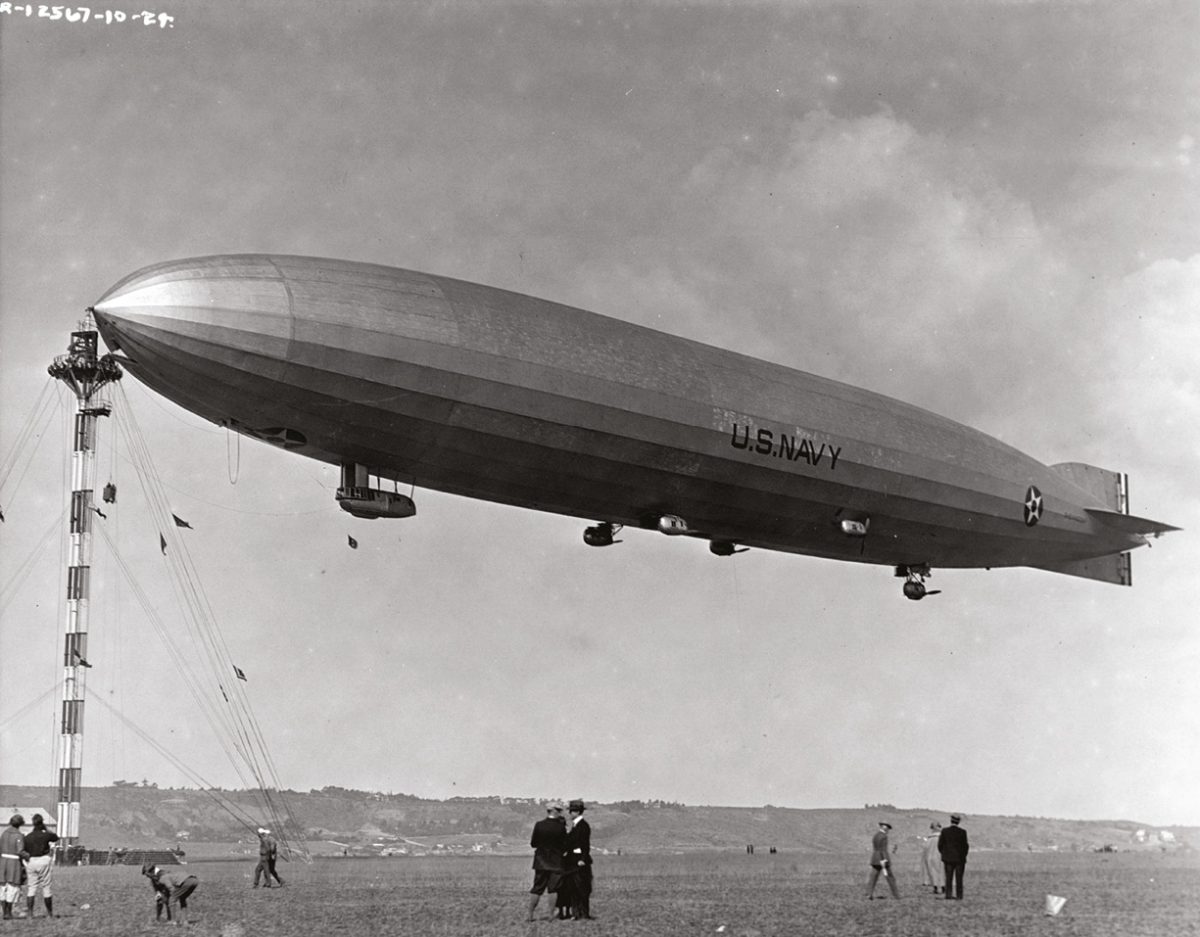
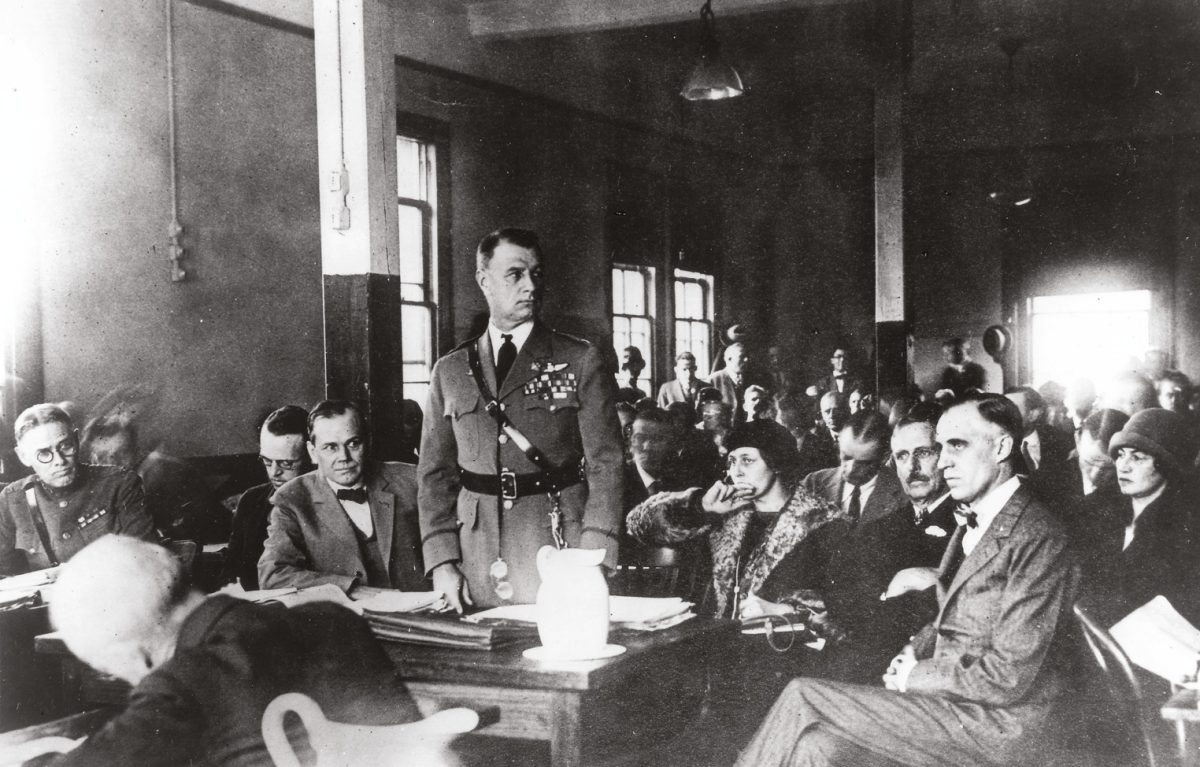
Mitchell undoubtedly exaggerated the ability of heavy bombers to inflict serious damage on manoeuvrable ships, while in level flight at high altitude. As Japan’s sinking of the Royal Navy ships Prince of Wales and Repulse off Malaya in December 1941 would show, the future lay with torpedo- and dive-bombers. He eventually overreached himself, accusing the US military and naval administration of criminal negligence following the ditching of a flying boat in the Pacific and the loss of the airship Shenandoah over Ohio in 1925. This brought court-martial proceedings down on Mitchell’s head, resulting in his departure from the service.
Although his own career ended in disgrace, Mitchell’s charismatic championship of airpower inspired a coterie of dedicated supporters. Henry ‘Hap’ Arnold, who headed the force in 1938-1946, his successor Carl Spaatz, and Ira Eaker, wartime head of Eighth Air Force, later refined his vision. In response to public hostility to indiscriminate attacks on centres of population, and with a view to improving the accuracy of their aircraft, they built a case for daylight precision bombing which would be tested in World War II. Meanwhile, in the largely unfavourable political and financial climate post-1918, pilots attracted publicity by taking part in air shows and a series of long-distance flying feats.
It was the rise of aggressive authoritarian regimes in the 1930s that gave a decisive push to the growth of US airpower. The US Army Air Corps, as the organisation had been rechristened in 1926, was entering a time of rapid technological change. Canvas-covered wooden biplanes, with open cockpits and fixed landing gear, were being replaced by all-metal monoplanes with enclosed cockpits and retractable undercarriage. As the operating range of military aircraft increased, it seemed possible that the American homeland might for the first time be threatened from the air.
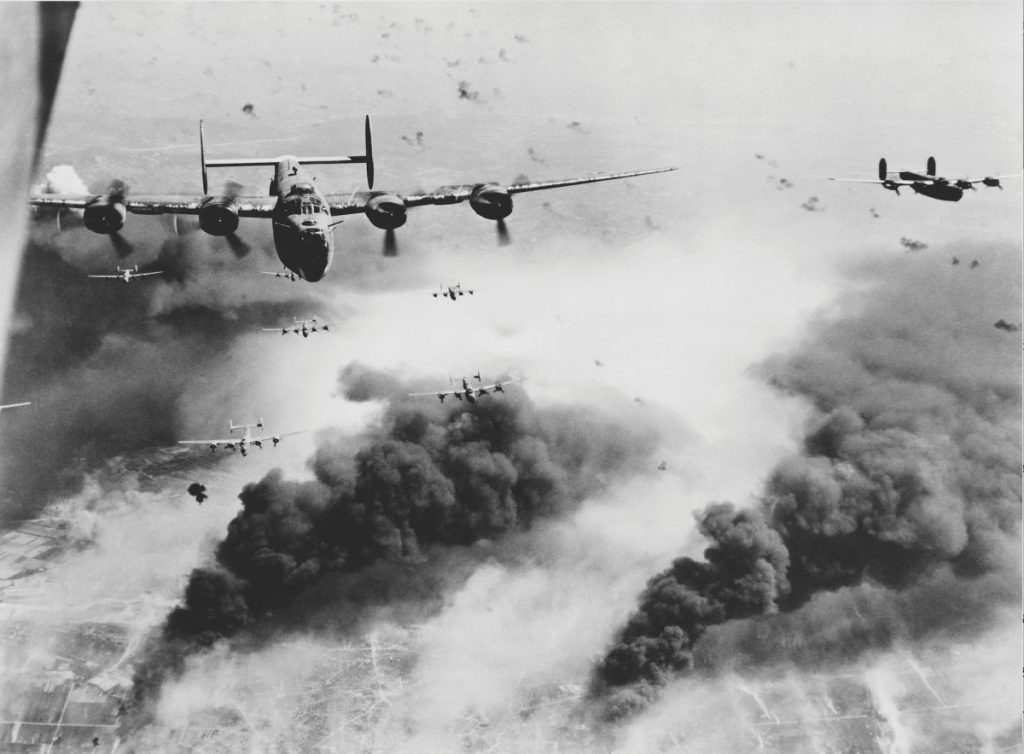
The Air Corps leadership believed that it needed long-range bombers, capable of carrying a much-increased payload. If they could not outpace the new generation of faster monoplane fighters, they must be able to defend themselves against them. This was the background to the development of the heavily armed Boeing B-17 Flying Fortress and the Consolidated B-24 Liberator, which were to be the mainstay of US bomber forces in World War II.
Crucially, the new president Franklin Roosevelt was a convinced supporter of airpower, despite having served as Assistant Secretary of the Navy in World War I. Viewing the rise of Nazi Germany with anxiety, he was certain that if war broke out, Western Europe, including Britain, would be quickly overrun. A victorious Hitler might then turn his attention to Greenland and Africa, using them as a springboard for the penetration of the American landmass. Massive investment was needed to create an air force capable of keeping the ‘potential enemy many hundreds of miles away from our continental limits’.
Despite the continuing isolationist mood in the US, Roosevelt called on the War Department at a meeting in November 1938 to plan for 10,000 new aircraft. By May 1940, the president was asking for 50,000 planes a year, along with 30,000 trained pilots. This was welcome to the newly appointed Air Corps chief Hap Arnold, although he made the argument that aircraft and personnel were not enough on their own – the government must also fund improved training and new bases.
Global war
In the summer of 1941, a further reorganisation of the air-arm was carried out. This time it involved more than a mere name change. The creation of the US Army Air Forces (USAAF) marked a major step towards independence. As its head, Arnold was directly responsible to the Army Chief of Staff, General George Marshall, with membership of the Chiefs of Staff in Washington DC.
Meanwhile, even before the US formally joined the war, closer links with the UK military establishment were being forged behind the scenes. Although there was pushback from the US Navy leadership, which was more concerned with the Japanese threat in the Pacific, there was a clear understanding that the defeat of Germany would be given priority.
Arnold’s stewardship saw a remarkable expansion of capacity to meet the rising global challenge. Between 1939 and 1944, the number of aircraft increased from a meagre 2,400 to almost 80,000, while total personnel numbers rose from 20,000 to a peak of 2.4 million. To make this possible entailed the mobilisation of industry on a massive scale. Experienced managers such as Henry Kaiser, who had already revolutionised the American shipbuilding industry, were drafted in to handle aircraft production. The assembly-line process at the Consolidated plant in San Diego was overhauled by Charles Sorensen, enabling the firm to turn out 100 B-24 bombers a month. The large-scale enrolment of women in the workforce, with 475,000 engaged in aircraft manufacturing by the end of 1943, was celebrated in the iconic figure of ‘Rosie the Riveter’.
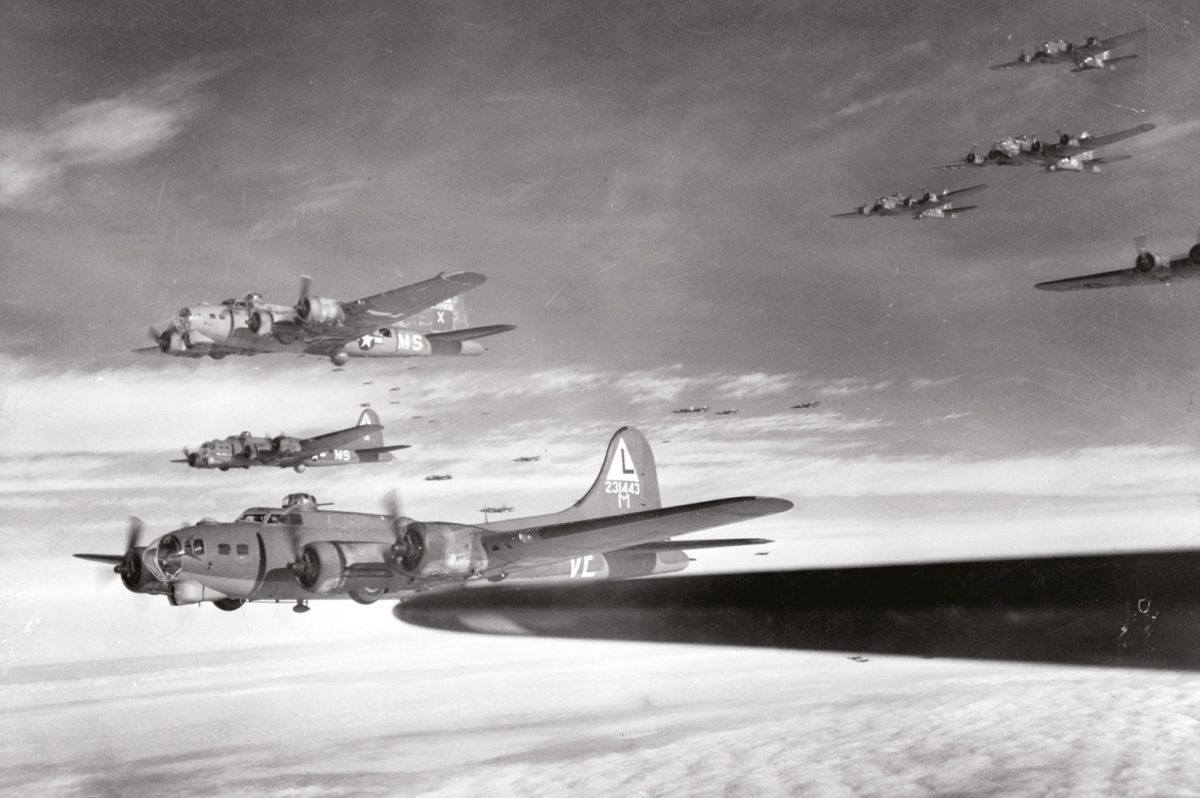
From June 1942, USAAF aircraft began arriving in the UK to complement the work of RAF Bomber Command. Across East Anglia, Eighth Air Force bases were established, from which B-17 and B-24 crews flew daylight bombing missions over Nazi-occupied Europe. At the January 1943 Casablanca conference, attended by Roosevelt and Winston Churchill, it was agreed that the USAAF and RAF would coordinate a round-the-clock bombing campaign to maximise the damage to Germany’s war-making capacity. The Americans continued with daylight raids, notwithstanding significant losses, while the RAF concentrated on night bombing.
The strategic bombing campaign faced many challenges. A shortage of shipping space made it difficult to provide a steady flow of supplies and replacement machines across the Atlantic. The Mediterranean and North Africa theatres, and the ongoing campaign against the U-boats, absorbed resources that could have been used in Western Europe.

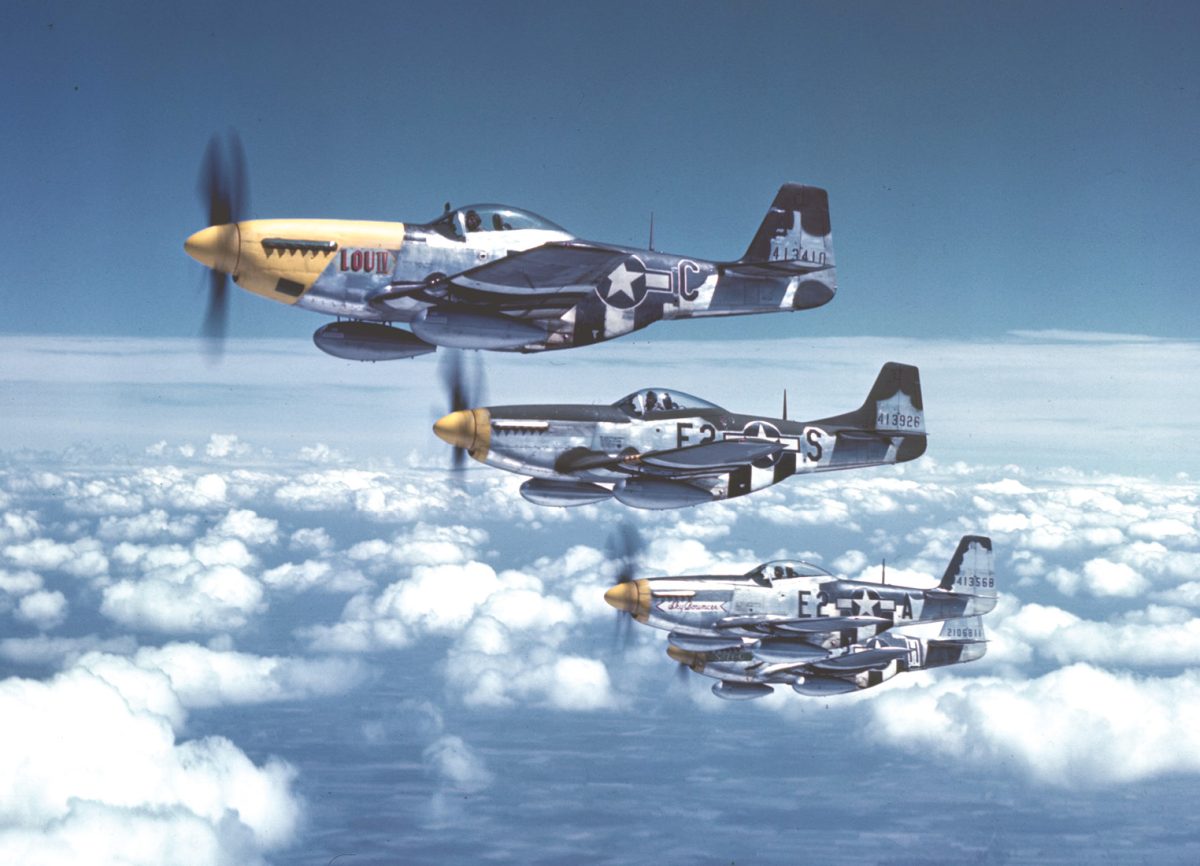
To protect bombers flying deep into Germany, a viable long-range fighter escort was needed. The problem was highlighted by the August 1943 Schweinfurt-Regensburg raid, in which 60 B-17s – a quarter of all the bombers that reached the target – were lost. The introduction of the superb P-51 Mustang escort at the end of 1943 proved to be a game-changer. US losses during ‘Big Week’ in February 1944 equated to 6% of the force, compared with an average of 20% the previous year.
The USAAF played a key role in the lead-up to the liberation of Europe from Nazi control. Following the June 1943 Pointblank directive, bombers targeted German aircraft production in order to guarantee allied air superiority when the invasion began. In the months prior to the Normandy landings, USAAF bombers joined the RAF in disrupting communications across northern France, to hamper the movement of German reinforcements to the coast. Douglas C-47 Skytrains acted as glider tugs and dropped some 50,000 paratroopers over the invasion zone on D-Day. Meanwhile, Fifteenth Air Force, stationed around F
In the Asian theatre, 1944 saw the appearance of an advanced new bomber, the B-29 Superfortress. Stationed first in China, and then in the Marianas, 1,500 miles from the Japanese mainland, the purpose of this aircraft was to destroy the enemy’s war economy. In March 1945, a low-level incendiary attack on Tokyo created a firestorm in which 16 square miles were laid waste, killing at least 100,000 people and making one million homeless. Arnold was convinced that sustained bombing of this kind could win the war without the need for a land invasion or the use of atomic bombs. Nonetheless, it was B-29s that dropped the atomic bombs on Hiroshima and Nagasaki in August 1945, opening a new chapter in warfare.

Cold War challenges
The post-war years saw the air force finally emerge as an independent institution. The outcome for which Mitchell, Arnold, and others had campaigned was realised in September 1947 with the official formation of the USAF. Three branches with distinctive functions were created. The nuclear deterrent, first to be carried by bomber aircraft and then in the form of intercontinental ballistic missiles (ICBMs), was the responsibility of Strategic Air Command (SAC). Tactical Air Command (TAC) controlled the fighter force and maintained a mobile strike capability. The role of the third element, Air Defence Command (ADC), was to protect US air space.
Initially, just as after 1918, administrative reorganisation was accompanied by a cost-driven running down of US airpower capacity. In the space of 18 months, US Air Force strength in Europe was cut from 17,000 aircraft to 2,000, and from 500,000 personnel to 75,000. But the hardening of Cold War tensions, culminating in President Harry Truman’s March 1947 pledge to resist the advance of world-wide Communism, soon put this trend towards demobilisation into reverse. In the 1948-1949 Berlin Airlift (see MHM 151, April/May 2026), the USAF – alongside the RAF – performed an immense logistical feat to break the Soviet blockade of the city. In 15 months, the two air forces delivered 2.3 million tons of food, fuel, and other supplies, three-quarters of which were flown in by the USAF.
The detonation of the first Soviet atomic bomb in August 1949 spurred an arms race between the two opposing blocs. The outbreak of the Korean War the following June lent urgency to the expansion of the air force, with the number of personnel in the Far East Air Force almost quadrupling by the end of the conflict three years later. This was a transitional war in terms of aviation hardware, with piston-engined B-29s playing a role, while the first effective US jet fighters, the Lockheed F-80 Shooting Star and the North American F-86 Sabre, fought Soviet-built MiG-15s.

Under the aggressive, driven leadership of General Curtis LeMay, Strategic Air Command became the platform that would have been responsible for striking the Soviet Union in the event of all-out war. The bluntly spoken LeMay was an uncompromising advocate of using overwhelming strength, either to deter an opponent or to win a war. He was later to be caricatured as the grotesque General Jack D Ripper in Stanley Kubrick’s satirical fantasy film about nuclear war, Dr Strangelove.
In October 1948, LeMay took over an organisation that was decidedly unprepared for the scale of challenge presented by the Cold War. Ruthless in sacking the inefficient, he was assiduous in training and incentivising the SAC crews for the grim task they might have to perform. He presided over a dramatic modernisation of the bomber force, which by the end of his term in 1957 was equipped with the formidable power of the eight-engined, jet-powered B-52, still in service 70 years later.
By the mid-1950s, the USA possessed unequalled strength in the air as it confronted its Soviet adversary around the globe. The USAF was the only one of the three services to enjoy a constant increase in year-on-year spending. By the end of the decade, it was taking responsibility for a growing arsenal of ICBMs, as well as maintaining its long-range bomber force. A global chain of bases, from the UK to Turkey, underpinned the strategy. Before the introduction of space satellites, long-range spy planes carried out vital surveillance, with the high-altitude Lockheed U-2 entering service in 1956.
Yet the future presented new challenges. The Kennedy administration took office in January 1961 with a desire to scrutinise the value derived from ballooning military spending. A new concept of ‘flexible response’ to international crises superseded the notion, associated most prominently with Curtis LeMay, of ‘massive retaliation’. The Vietnam War would prompt an intense debate about the effectiveness as well as the morality of large-scale aerial bombardment. American airpower showed itself to have significant limitations alongside its awesome potential.
• Dik Daso, Hap Arnold and the Evolution of American Airpower (Smithsonian Books, 2000).
• Donald L Miller, Masters of the Air: how the Bomber Boys broke down the Nazi war machine (Simon & Schuster, 2007).
You can read the second part by Graham Goodlad 'From biplane to B-52' here and find an infographic about US airpower here.
All images: Wikimedia Commons, unless otherwise stated