
Another Nefertiti
Two decades after the discovery of the famous Berlin bust, a chance discovery was made in 1933 of a sculptors’ workshop at Amarna containing another unfinished head of Akhenaten’s queen.

Two decades after the discovery of the famous Berlin bust, a chance discovery was made in 1933 of a sculptors’ workshop at Amarna containing another unfinished head of Akhenaten’s queen.

In 2022, MOLA archaeologists working on the Liberty development site in Southwark on behalf of Landsec, Transport for London (TfL), and Southwark Council, uncovered a pair of striking Roman mosaics. This beautiful flooring featured stunning flower motifs in black, yellow,…

The Hill of Tara, once the seat of the High Kings of Ireland, is a site steeped in mythology and history, dating back over 5,000 years. At the centre of the image lies the Mound of the Hostages, an ancient…

In this image, St Paul’s Cathedral is dramatically illuminated on the night of VE Day, 8 May 1945, which marked the end of the Second World War in Europe. Sir Christopher Wren’s masterpiece in central London had survived the war…

You would be forgiven for thinking that the beautiful architecture represented here had been carved from stone centuries ago. Instead, this is a mural, recently unveiled at St Drostan’s church in Markinch, Fife, that has been created as a faithful…

The only reference to Israel ever found in Egypt, inscribed on a stela discovered in 1896 by Flinders Petrie.

Until around 8,000 years ago, Britain and the European mainland were connected by a land bridge that today is known as Doggerland. Although now submerged beneath the North Sea, this lost landscape has been recreated in an interactive simulation by…

This theatre is part of the archaeological site of Aptera, near present-day Chania, in western Crete. The ancient coastal city-state was once one of Crete’s most important commercial centres, at its peak in the Hellenistic period (late 4th-3rd centuries BC).…

In this dramatic photograph – taken on 30 April 1975, 50 years ago this spring – a North Vietnamese tank is pictured at the climactic moment, as it smashes through the gates of the Presidential Palace in Saigon. The fall…
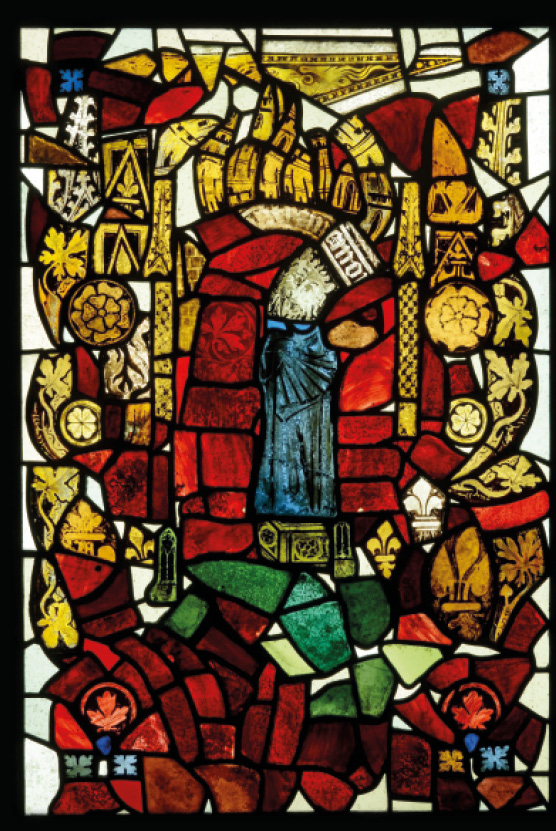
In 1946, 500 fragments of brightly coloured stained glass were removed from the window of St Andrew’s Church, Heckington, to make way for a modern replacement. This was not their first move – the fragments, which are mainly thought to…

The Narmer Palette may be regarded as the world’s first historical document, recording the unification of Upper and Lower Egypt in about 3000 BC.

These photographs show a colourful mosaic at North Leigh Roman Villa: the only example in Oxfordshire that remains in situ. The villa was excavated in 1813 by Henry Hakewill, and originally boasted at least 19 geometric mosaics. Today, only one…

A small, ornately decorated house has been uncovered in Pompeii during ongoing excavations of the Insula of the Chaste Lovers, in the centre of the ancient city. Archaeological investigations of this newly discovered residence are still under way, but it…

When it was excavated in the 1960s, Fishbourne Roman Palace generated an archive that, for the time, was incredibly structured and detailed. However, by today’s standards, little attention was given to distribution of artefacts across the site, or relative locations…

Celebrating the work of the British pioneer of Egyptian prehistory.

A giant ephemeral land artwork the size of four Olympic swimming pools has been unveiled by Sir Tony Robinson at Whitby Abbey, to mark the 30th birthday of the National Lottery and celebrate the achievements of seven heritage ‘Game Changers’.…

For the first time in 40 years, a new effort is under way by archaeologists from the University of Toronto, in collaboration with local scholars, to document the pre-Hispanic city of Pacatnamu in the Jequetepeque Valley of northern coastal Peru.…

This image shows the remains of a horse excavated recently from a trench at Mont-Saint-Jean Farm in Waterloo, Belgium. The farm was the site of a field hospital for the Duke of Wellington’s troops in the aftermath of the battle…

When skeletal timbers emerged from intertidal deposits at Sand o’Erraby beach on Sanday, Orkney, earlier this year, they were soon identified as part of a shipwreck – specifically, the midships section of a vessel’s lower hull. Current thinking is that…

Previously overlooked fragments dramatically change our knowledge of foreign contacts in the Middle Kingdom.

Stylised dolphins and fish, in contrasting hues of red, blue, and yellow, swim across a sea of white tesserae. This striking mosaic was uncovered during excavations at Wroxeter Roman City (ancient Viroconium) in a collaborative effort by the University of…

A reproduction of a type of Bronze Age vessel known as a ‘Magan Boat’ has just completed its maiden voyage off the coast of Abu Dhabi. The ‘Magan Boat’ is named after an ancient region in present-day Oman and the…

This image shows a huge crowd of German soldiers captured by British forces during the Battle of Amiens on 27 August 1918, less than three months before Armistice Day. Taken at the town of Abbeville, well behind the frontline, the…

A recent initiative has been working to restore the profile of the Uffington White Horse, a Bronze Age hill-figure in the care of the National Trust. When a drone survey (fundraised by David Miles and Simon Palmer, and undertaken by…

Petrie’s work at Naqada revealed for the first time the prehistoric past of Egypt.

Pendinas hillfort is a well-situated pre-Roman defended village, commanding a prominent hill on the west coast of Cardigan Bay. The Iron Age hillfort developed over several centuries, eventually encompassing both the steeper south summit and the lower north summit. Everything…

An ornately decorated mastaba has been discovered in the cemetery at Dahshur, the southernmost of the necropolises associated with Memphis, an ancient Egyptian capital. The tomb was discovered during recent excavations by the German Archaeological Institute (DAI), Cairo, which has…

This image shows a castle door, which was etched with some macabre graffiti by English soldiers during the Napoleonic era. The simple wooden plank door, from the top of a remote tower in Dover Castle, was rediscovered years ago, but…

During this season’s work at the Oxfordshire site of Besselsleigh deserted manor and village (CA 400) by Appleton Area Archaeological Research Project (AAARP), the team of volunteers and students from the Oxford University Department for Continuing Education (OUDCE) excavated the…

Towards the end of the 19th century, when wives were regarded as the property of their husbands and not expected to have a university education or an independent career, several remarkable women emerged as influential in the field of Egyptology.…

For more than a decade, Adam Stanford and English Heritage have periodically recorded the parch marks that appear at Stonehenge in the summer, when conditions are right. Until recently this involved oblique low-level aerial photography via mast, kite, or drone.…

The Dolmen of Guadalperal is a megalithic tomb located in the Spanish province of Cáceres, some two hours south-west of Madrid. The site is believed to be a Neolithic funerary monument, probably constructed between the 5th and 4th millennium BC.…

In this image, a diver surveys one of the five cannon found during an archaeological exploration in Dry Tortugas National Park, off the south-west coast of Florida. The cannon played a crucial role in confirming that a nearby wreck, first…

A new publication, An Early Medieval Craft: antler and bone working from Ipswich excavations 1974-1994, details the extraordinary Viking Age finds discovered over the course of 20 years of digging in the town by Suffolk County Council Archaeological Service (SCCAS).…

Situated in the north-eastern part of the Nile Delta, ancient Djanet (Tanis) was the residence and burial place of the kings of the Twenty-first and Twenty-second Dynasties. In the late 1930s and early ’40s, a complex of royal tombs was…

Llanfair-Mathafarn-Eithaf Community, Anglesey