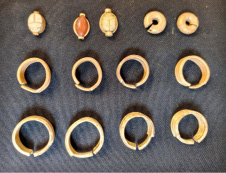
gold

Heliopolis funerary set

Archaeologists working at ancient Heliopolis (Matariya, Cairo) have uncovered an almost complete funerary assemblage beneath a mud-brick burial structure. The discovery includes a collection of personal and ritual objects, including a copper mirror, alabaster kohl vessels containing traces of cosmetics,…

Annette Græsli Øvrelid, Museum of Archaeology, University of Stavanger

Gold filigree fitting

It was found by a walker in a rock crevice. What is it? This spectacular sword scabbard fitting dates to the 6th century, during Norway’s Migration Period. The rectangular object measures 6cm wide by c.2cm high and is just a…

In the grip of gold

A unique exhibition at the Wereldmuseum Leiden in the Netherlands explores how gold has inspired humankind throughout history. Gillis Kersting visited to find out more.

Fields of gold: Understanding the Snettisham Hoards

Over the course of eight decades, at least 14 separate hoards of Iron Age metalwork have been recovered from a single field at Snettisham in Norfolk. Now, following the publication of a new book describing the excavation, conservation, and scientific investigation of these spectacular finds, Jody Joy and Julia Farley describe how they came to be discovered, and reveal some of the secrets that have come to light since then.

Vindelev Odin bracteate

Gold bracteate

What is it? This gold pendant, known to specialists as a bracteate, is 5cm in diameter and comes from a Danish hoard dated to the 6th century AD – the object itself dates to the early 5th century. The front…

Left A gold ring found in the Northern Cemetery at Amarna bearing the hieroglyphs ‘Daughter of the Lady of the Two Lands’. above A necklace of hollow gold beads also found at Amarna.

Golden jewellery found in burial in Amarna

The Egyptian-British archaeological mission working in the Northern Cemetery (Tombs of the Nobles) at Amarna has uncovered a burial containing fine pieces of gold jewellery. The grave contained the remains of a young woman wrapped in textiles, who was buried…

Finds tray – a gold bulla

This pendant, known as a bulla, was found by a metal-detectorist in the Melton district of Leicestershire in November 2021. It is hemispherical in shape and formed of two plain gold sheets, one formed into a hollow dome and the…

40273ed42eb2485e9eeaab7ddd0dcc71

This week: The Harpole Treasure

It was, according to Levente Bence Balázs, the leader of the Museum of London team that made the discovery, a moment that might most accurately be described as ‘an archaeologist’s dream’. On 11 April 2022, Balázs was overseeing the penultimate…

Opposite Some of the components of the 7th century Harpole Treasure, the richest necklace of its kind ever found.

Harpole’s hidden gem: excavating early medieval Britain’s most significant female burial

Archaeological work just outside Northampton has uncovered an internationally significant burial, furnished with a remarkable 7th-century necklace, as well as a number of other high-status grave goods. With conservation and analysis of the finds under way, Carly Hilts spoke to Paul Thompson and Lyn Blackmore about what these artefacts can tell us about the woman they were buried with, and what they could add to our understanding of early medieval England as research progresses.

Treasure of Mercia

The Staffordshire Hoard – the largest cache of Anglo-Saxon gold and silver ever found in Britain – is predominantly made up of weapon parts and other martial gear, including sword fittings, ceremonial objects, and fragments of a helmet (see CA…

Illuminated Psalter MET DT5343

This week: Golden manuscripts

Throughout history, gold has captured the imagination – as a glittering symbol of money, sex, power, divine love, or whatever else our hearts desire. From the Greek myth of the Golden Fleece to Titian's Danae, and from the golden objects found in Ancient Egyptian tombs to the quest at the heart of JRR Tolkien's Lord of the Rings, the precious metal has been mined as subject matter for writers and artists across continents and down millennia.

Written in gold: exploring golden manuscripts from around the world

Some of the most significant texts from around the world have been given very special treatment, with words of holiness and of diplomatic value written both in and on gold. Annabel Teh Gallop, Eleanor Jackson, and Kathleen Doyle investigate the indelible importance of the precious metal in luxury manuscripts.

Fragments of the Bronze Age

Review by Chris Griffiths. Those with an interest in Bronze Age metalwork will know that the literature tends to focus on the question of why metal objects were destroyed and buried: were they deliberately broken for recycling, to serve a…

1280px Chateau de Versailles salon de Diane Jason et les Argonautes debarquant en Colchide Charles de La Fosse

This week: Gold in the Caucasus

It remains one of the best known of all Greek myths – not least, for a certain generation, because of the lurid 1963 Hollywood film adaptation. But if the story of Jason and the Argonauts' quest for the Golden Fleece continues to grip the popular imagination, the question of how far it is based in reality is also one that fascinates historians, classicists and archaeologists alike.

Jason Pelias Louvre K127

The Golden Fleece paradox

The Caucasus were home to some of the world’s earliest and most proficient goldsmiths. Despite an association between this metal and the mountains that became so strong it was woven into mythology, gold artefacts more or less disappear from a large part of the region for a period of some seven centuries. Nathaniel Erb-Satullo investigates why.

Family ties: deciphering the DNA of the Amesbury Archer and the Companion

Twenty years ago, one of the richest Bell Beaker burials ever found in Europe was discovered close to Stonehenge. At that time, DNA analysis was not sufficiently advanced to learn more about the individual, dubbed ‘the Amesbury Archer’ – but the intervening decades have seen significant scientific advances that have shed illuminating light on this enigmatic figure, as well as his relationship to a younger man buried nearby. Andrew Fitzpatrick, Jacqueline McKinley, Alistair Barclay, Ian Armit, Iñigo Olalde, and David Reich report on what has been revealed.