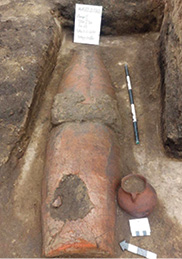
funerary practices

Tell Kom Aziza cemetery finds

An Egyptian team excavating the multi-period cemetery at Tell Kom Aziza (Beheira) in the Delta has uncovered a section dating to the Graeco-Roman Period with diverse human funerary practices. Burials ranged from simple pits and mud-brick-lined tombs, to decorated gypsum…

World news

Africa’s oldest cremation? Archaeological investigations in the shadow of Mount Hora, in northern Malawi, have revealed the oldest evidence for human cremation yet found in Africa. The burial, which dates to c.9,500 years ago, was discovered at a rock-shelter site…

Africa’s oldest cremation

Archaeological investigations by an international team of researchers have unearthed the earliest evidence for intentional human cremation in Africa. Around 9,500 years ago, a community of hunter-gatherers gathered more than 30kg of wood and grass to build a large funeral…

Ancient Egypt February listings

CHILDHOOD AND ADOLESCENCE IN ANCIENT EGYPT The exhibition traces the daily lives of young ancient Egyptians, with a display of more than 190 pieces from national and international collections in the Vimcorsa Room, accompanied by an immersive audiovisual experience in…

Sheshonq shabtis

The Twenty-second Dynasty Libyan king Sheshonq III (c.825-773 BC) may have been buried in the tomb of a predecessor, Osorkon II, according to a new discovery at San al-Hagar (Tanis). The Tomb of Osorkon II was discovered in 1939, but…

The UK’s first crematorium

Sherds was intrigued to encounter two interesting items recently that have to do with the treatment of human remains. (Anyone who is grieving or has suffered a recent bereavement might like to skip over these reports.)

Twin sacrifice at Chichén Itzá

DNA analysis of human remains from a mass burial at Chichén Itzá in Mexico is revealing new details about the ritual practices of the ancient Maya, as well as their genetic links to modern populations. In 1967, the remains of…

A Mystery from the Mummy-Pits

REVIEW BY ROGER FORSHAW Frank Holt’s very readable account of Ankh-Hap, a Ptolemaic-era mummy appropriated in the 19th century from a tomb in Egypt, is a unique, informative, and fascinating contribution to the study of ancient Egyptian mummified remains. The…

The Bare Bones: Presenting a very regional Neolithic

During the early Neolithic period, a distinctive regional tradition of funerary architecture developed on either side of the waters stretching between Northern Ireland and south-western Scotland. Matt Ritchie explores how archaeological research and interpretation is helping to illuminate the chambered cairns of the North Channel and the people who built them, and describes the role they can play in developing an understanding of place and time in younger audiences.

Below A workshop discovered near the pyramid of Pharaoh Unas is offering new insights into the embalming process in ancient Egypt.

Life and death

The British Museum said that it would continue to use the word ‘mummy’, but would use the name of the mummified person wherever this was known

ABOVE This gilded mummy belonging to a woman called Isaious was discovered at Hawara in 1911. The mummy mask’s facial features and hairstyle are reminiscent of Ptolemaic ideals, while other elements of the cartonnage feature traditional Pharaonic iconography, reflecting the multiculturalism present in burial traditions in Egypt at the time.

Golden Mummies of Egypt

An internationally touring exhibition featuring mummies and artefacts from Graeco-Roman Egypt has opened in the UK for the first time at the newly refurbished Manchester Museum. Amy Brunskill visited to find out more.

King Tut Burial Mask

Mummies Quiz

In 1922, a team led by which British Egyptologist excavated Tutankhamun's tomb?

Stonehenge

The World of Stonehenge

Review by HB. This accessible and richly informative book, produced to accompany the World of Stonehenge exhibition at the British Museum (CA 384), treats Stonehenge as a ‘gateway’ into the interconnected worlds of British, Irish, and European prehistory. Wooden poles…

Egyptian afterlives: an interview with Salima Ikram

As shown by the excitement surrounding the discovery of Tutankhamun 100 years ago, mummies and Egyptian tombs have an impressive ability to capture our imagination. Richard Marranca speaks to Egyptologist Salima Ikram to find out more about these funerary finds, from early medicinal mummies to recent revelations at Saqqara.

BELOW The Warsaw Mummy Project uses a range of techniques, including X ray and CT scanning, to find out more about ancient Egyptian mummies.

The Warsaw Mummy Project

A multidisciplinary project that uses a wide range of techniques to study ancient Egyptian mummies is shedding new light on the secrets hidden beneath their wrappings, as Marzena Oz.arek-Szilke, Marcin Jaworski, Wojciech Ejsmond, and Stanisl´aw Szilke explain.

OPPOSITE The peat mummified hand of Old Croghan Man, from Co. Offaly, preserves intimate details including the texture of his skin and the shape of his fingernails. Bog bodies like this are particularly resonant archaeological discoveries, being so recognisably human.

Touching the past: encountering Iron Age bog bodies

Bog bodies are particularly potent archaeological discoveries, representing the recognisable faces of people from the past. Why were so many of these figures consigned to watery graves during the Bronze and Iron Ages, and what are scientific advances adding to our understanding of these enigmatic individuals? Current Archaeology's Carly Hilts explores thought-provoking recent research by Melanie Giles.

Ages and Abilities

The primary aim of this volume is to address the issue of bioarchaeological age assessment and the different social responses to ages and maturing within past societies

Post 1 image0

The Greek dead and the Great Beyond

The ancient Greeks thought much about the dead – how their remains should be disposed of, how their spirits might be summoned, how malignant they could be if unavenged. Classicist David Stuttard brings us face to face with the Greek dead.