Burial

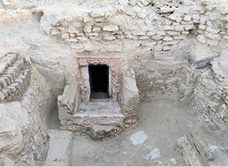
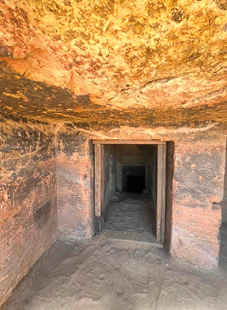
Bubasteion rock tombs

Three rock-cut tombs belonging to high officials of the early New Kingdom have been discovered by an Egyptian team in the Bubasteion necropolis at Saqqara. The tombs are inscribed with their biographies, and provide important evidence of Egypt’s foreign relations…
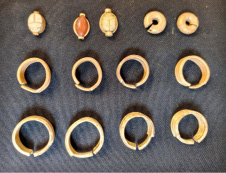
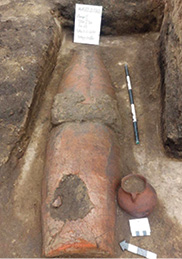
Heliopolis funerary set

Archaeologists working at ancient Heliopolis (Matariya, Cairo) have uncovered an almost complete funerary assemblage beneath a mud-brick burial structure. The discovery includes a collection of personal and ritual objects, including a copper mirror, alabaster kohl vessels containing traces of cosmetics,…

Tell Kom Aziza cemetery finds

An Egyptian team excavating the multi-period cemetery at Tell Kom Aziza (Beheira) in the Delta has uncovered a section dating to the Graeco-Roman Period with diverse human funerary practices. Burials ranged from simple pits and mud-brick-lined tombs, to decorated gypsum…

Newly discovered Qurna tomb

A Dutch team from Leiden University has discovered a previously unknown Ramesside tomb in Sheikh Abd el-Qurna. Wall inscriptions name the owner as an official called Paser. The tomb has a typical Theban layout, with an open courtyard containing a…

AE156 News 2a

Hyksos-era complex

A large multi-functional complex dating to the Fifteenth Dynasty (the Hyksos era) has been uncovered by an Egyptian mission at Tell el-Ku’a in Wadi Tumilat (Ismailia Governorate) in the eastern Nile Delta. The team discovered a walled residential compound, measuring…

Image001

World news

New insights into the Plain of Jars in Laos Xieng Khouang Plateau in northern Laos is dotted with hundreds of ancient stone jars. While they have been the subject of archaeological investigations for over a century, their full use and…

CWA news in brief

Pompeii reoccupied after eruption Excavations at Pompeii have uncovered evidence that certain areas of the city were reoccupied after the eruption of Vesuvius in AD 79. This had been suggested before, but previous excavations focused on reaching Pompeii’s pre-destruction levels…

More news from Aswan

Three rock-cut tombs from the Old Kingdom, reused during the Middle Kingdom, have been found by the Egyptian team working at the Qubbet el Hawa necropolis opposite Aswan. Two of the tombs have similar features and contained wooden coffins with…

Gene sequencing

A 4,500-year-old Egyptian skeleton from a rock-cut tomb in Nuwayrat, near Beni Hasan, has provided the first biological evidence for links between ancient Egypt and Mesopotamia in the early Old Kingdom. The man’s unusual burial – in a sealed pottery…

Image

This week: Elites

These days, it sometimes seems hard to read a newspaper, or scan a news website, without coming across an article about the ‘new elites’ who run our world. Often this is in reference to the richest ‘1 percent’, who are…

Post 1 image0 115 749x1024

Cladh Hallan: exploring the roundhouse way of life in South Uist

Located in the Outer Hebrides, the prehistoric settlement of Cladh Hallan is best known for the Bronze Age mummies found buried beneath its roundhouses. As well as these insights into how the dead were treated, though, the dwellings have yielded illuminating insights into the world of the living, as Mike Parker Pearson, Jacqui Mulville, Helen Smith, and Peter Marshall explain.

MaskOfAgamemnon 1024x1024

This week: Gold

According to a recent estimate by the World Gold Council, the total quantity of this precious pale yellow metal discovered around the world throughout all of human history amounts to just 201,296 tonnes. If the whole lot were melted down to form a single cube, it would measure just 22 metres on each side.

ABOVE The 2.5m long early Bronze Age log coffin was excavated by archaeologists from the University of Sheffield, then brought to the York Archaeological Trust for analysis and conservation.

Buried in the Bronze Age: unearthing a rare log coffin in Lincolnshire

The discovery of 4,000-year-old log coffin and the remains of its occupant in Tetney, Lincolnshire, along with an equally rare stone axe buried with it, has brought together archaeologists from across the field in a massive effort not only to excavate and preserve the wood before it can disintegrate, but also to examine every avenue of evidence that this unique burial can provide. Hugh Willmott, Tim Allen, and Ian Panter report on their ongoing efforts.

ABOVE These iron shackles were found padlocked around the ankles of a Roman man who had been interred at Great Casterton, Rutland. Might his burial represent rare direct evidence for slavery in Roman Britain?

Examining a shackled Roman burial at Great Casterton

The skeleton of a Roman man with iron shackles locked around his ankles has been described as ‘perhaps the most convincing candidate for the remains of a Roman slave yet to be found in Britain’. Current Archaeology's Carly Hilts reports on recently published analysis illuminating this unique burial.

RIGHT Burial B10 is one of 14 people buried at Knowth between the 1st and 3rd centuries AD. Isotope analysis has established that some members of the group came from northern Britain. The choice of this Neolithic monument for their burial was perhaps intended to create a link between the newly arrived people and the indigenous ancestors.

Mounds and monasteries: burials in late Iron Age and early medieval Ireland

The Irish archaeologist Barry Raftery (1944-2010) wrote: ‘Death represents the ultimate confrontation between the human and the supernatural worlds. The surviving burial remains and the associated funerary monuments thus provide us with the clearest and most tangible surviving evidence of religious beliefs and practices’. With this as her theme, Elizabeth O’Brien has studied every excavated Irish burial dating from the period c.200 BC to c.AD 800. She found great diversity and one common strand – burial in close proximity to ancestors or to people regarded as saints, as Chris Catling reports.

Below Individuals buried at the Hospital of St John the Evangelist had the lowest incidence of fractures, possibly because the inmates of the hospital were too ill to participate in risky activities.

Life and death in medieval Cambridge

Analysis of more than 300 human skeletons, recovered from three different medieval burial sites across Cambridge, has provided interesting new details of the city’s inhabitants, and the individual risks they may have faced based on their position in life. The…

Photo: Margrethe K H Havgar, Museum of Cultural History

World News: Norway, Indonesia, Spain

Viking ship burial in Norway A Viking ship burial was recently discovered at Gjellestad, Norway, during a ground-penetrating radar survey. It is now being excavated by the Museum of Cultural History in Oslo. The ship is just one part of…

Above More than 350 skeletons were recovered during recent excavation in Leith. Above right Underneath the medieval cemetery was a stand alone crouched burial when and why this woman was buried here remains a mystery.

Unusual burial discovered in Leith

A recent excavation along Constitution Street in Leith, in advance of an extension to the Edinburgh tram line to Newhaven, has uncovered hundreds of human remains from a late medieval cemetery and, underneath it, a mysterious stand- alone burial. The…