Subscribe now for full access and no adverts
Reviled when they were first constructed, cooling towers are now admired for their gracious hyperboloid curves and sculptural presence, just as they are about to disappear from the landscape. The Twentieth Century Society has described the group of eight towers at Ratcliffe-on-Soar, in Nottinghamshire, as ‘the Stonehenge of the 20th century’, and has warned that the cooling tower will be ‘extinct’ by the end of the decade if current demolition plans go ahead.

The first example in the UK was built to a Dutch design in 1924 at the Lister Drive coal-fired power station in Liverpool. By the 1960s, the UK had 240 towers, but with the phasing out of coal and gas-fired power stations, that number has now shrunk to 37. As well as Ratcliffe-on- Soar, there are others at Staythorpe and West Burton in Nottinghamshire, at Drax in North Yorkshire, and at Fiddler’s Ferry in Cheshire.
The Cooling Tower Appreciation Society is one of a number of community groups advocating the retention of some (or all) of the survivors. To the disappointment of campaigners, though, a listing application for Ratcliffe- on-Soar was turned down by Historic England, which has issued a ‘certificate of immunity’, assuring developers that the site cannot be listed or served with a building preservation notice for five years.
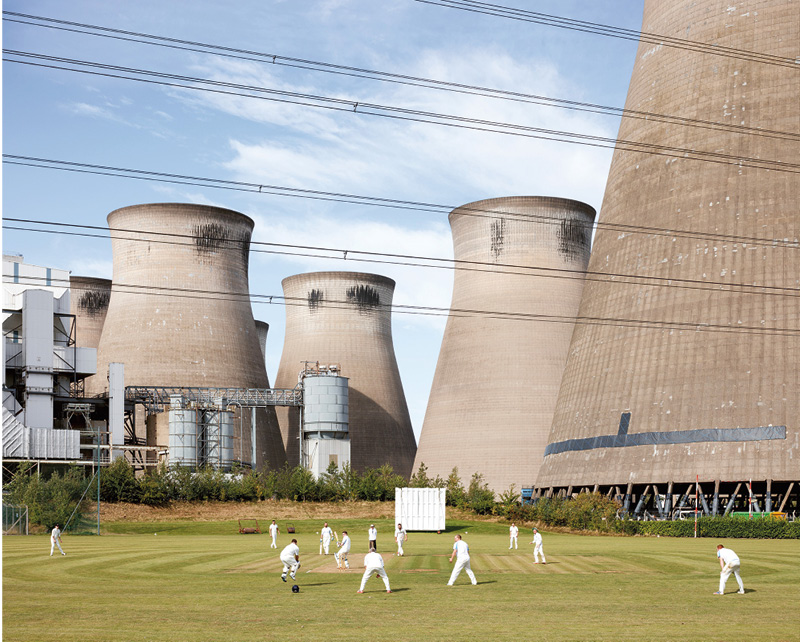
Retention involves a considerable maintenance cost, and the towers are difficult to convert to other uses without piercing the walls to let light into the interior, which then compromises the unbroken sweep of concrete that gives cooling towers their essential character. Conversion is not entirely impossible, however: in other parts of the world they have been used as climbing walls, for bungee jumping, and as the canvas for large murals, while the Venezia Heritage Tower in Porto Marghera, Italy, has been transformed into a venue for art exhibitions, conferences, and events, with panoramic views over the Venetian lagoon.
In the UK the campaigning continues, aided by the recent publication of Cooling Towers (for more details, visit http://www.batsfordbooks.com/book/cooling-towers-2/), a volume in which Antony Gormley, the Turner Prize-winning British artist, joins architectural writers and photographers in expressing admiration for these visually exciting and historically significant industrial relics.

Further information: http://www.facebook.com/groups/951708838254920/
Images: Neil Jackson; Christopher Catling

Is there a society that you would like to see profiled? Write to theeditor@archaeology.co.uk