
Subscribe now for full access and no adverts
Two medieval slabs have been raised from Studland Bay by a team of maritime archaeologists from Bournemouth University.
The slabs had been lying at a depth of 7m before they were raised in a two-hour operation, led by Diving and Maritime Archaeology Officer Tom Cousins, in June. They are thought to be coffin lids or grave markers for important members of the clergy, as signposted by the large cross engraved on each one, and are of considerable size and weight. One has been preserved in its entirety, measuring 1.5m long and weighing 70kg, while the other, broken in two pieces, is larger still, measuring a total of 2m and weighing a remarkable 200kg.
The 13th-century shipwreck that the slabs came from was discovered in 2019, when Tom and his team dived the site after having been tipped off by local charter skipper Trevor Small (see CA 390). It was named the ‘Mortar Wreck’ owing to the grinding mortars associated with the sunken vessel. These were created from the same stone as the slabs – Purbeck marble – which was quarried on the Dorset peninsula of the same name and was used liberally in medieval church buildings. Until now, experts have been unsure about how much of the manufacture of pieces like the slabs and mortars took place in the local area, and how much happened in London. However – save for a final polishing – the raised slabs were almost finished, which provides some answers to this question.
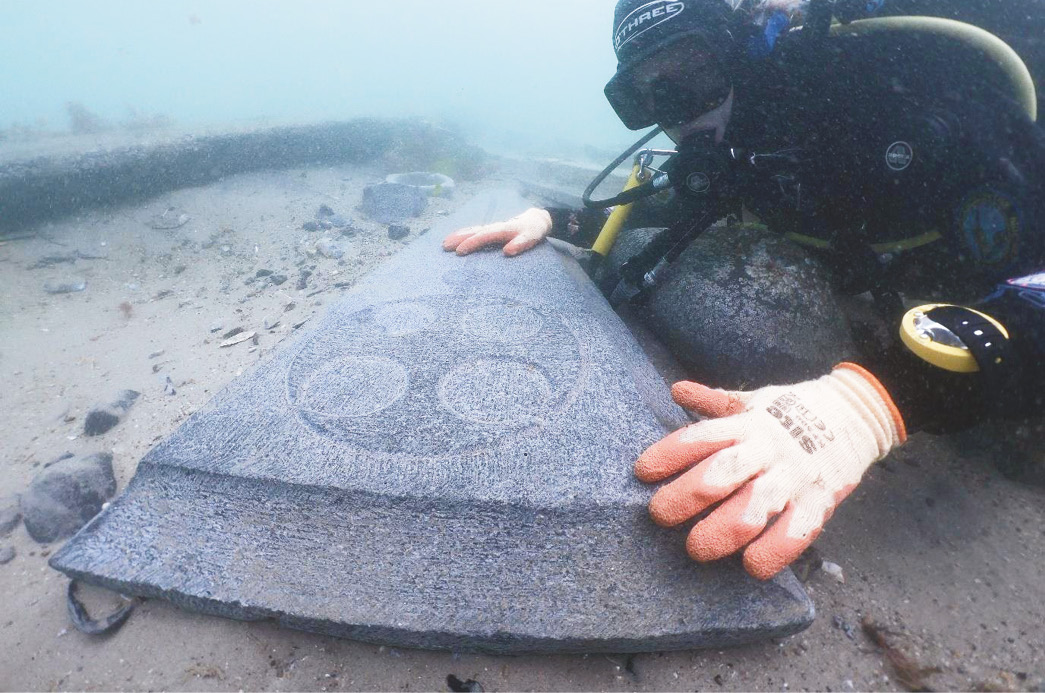
Purbeck marble is a building material that is particularly vulnerable, and the slabs are undergoing desalination and conservation work before being put on display in one of the new maritime galleries at Poole Museum, set to open in 2025.
The Mortar Wreck will take an important place in the museum as England’s oldest shipwreck that has evidence of the actual vessel still remaining. The surviving timbers of the hull are currently preserved by the sand at the bottom of the bay, but Tom is hopeful that future work on the site of the wreck will allow the university team to record and even raise this sunken material. Should this happen, the hull would be carefully recorded in situ using photogrammetry, and then again using structured light scanners before and after their conservation. The future of the wreck does not end there: the university will also continue to use the site as a training ground for future maritime archaeologists enrolled on their archaeology course.
Text: Rebecca Preedy