
Museum news
The latest on acquisitions, exhibitions, and key decisions.

The latest on acquisitions, exhibitions, and key decisions.

This is the latest in the ‘…in 20 Digs’ series. Gavin Speed has been involved in Leicester’s archaeology for more than 20 years, and he has produced a well-illustrated account of 20 key sites in Leicester (with a bonus 21st…

My recent ‘Odd Socs’ column on the Ancient Tree Forum (CA 436) proved to be unexpectedly topical when, on 18 June, it was announced that Sherwood Forest’s 1,200-year-old Major Oak had died. The expressions of sadness that followed showed that many people loved this tree and considered it an important part of our national heritage.

This is an iron fetter, probably from a set of shackles, dating to the Romano-British period. Found near Horncastle, Lincolnshire, following river-dredging, it is in exceptionally good condition, perhaps because of the waterlogged conditions in which it was found. The…

Archaeological investigations in advance of the A46 Newark Bypass scheme in Nottinghamshire have revealed a landscape scattered with features spanning six millennia. Archaeological Management Solutions (AMS) was contracted on behalf of National Highways to examine more than 23 acres (9.6ha)…

This early medieval finger-ring was found by a metal-detectorist near Quadring in Lincolnshire, south-west of Boston, in May 2024, and has more recently been declared Treasure. It is made of silver and dates to c.AD 700-1000. The middle of the…

The diverse grave goods excavated at a 6th-century cemetery in Nottinghamshire testify to a wealthy community with wide-ranging trade links – but, as well as new objects and materials, did these networks help to spread deadly diseases, and might this explain the unusually high number of multiple burials identified at Broughton Lodge? Carly Hilts visited a new exhibition about the site and spoke to Ann Inscker, Professor Chris Loveluck, and Dr Clare Pickersgill to learn more.

There are lots of great ways to get involved with history and archaeology over the next few months, including exhibitions, lectures, and conferences exploring a wide range of subjects. If you would prefer to get your heritage fix from the comfort of your sofa, though, there are various resources on offer online, too, from virtual site tours and digital offerings by museums to podcasts, TV shows, and more. Kathryn Krakowka has put together a selection of some of the options available.

Recent rock-art surveys in the Peak District National Park have documented more than 40 decorated panels dating to the Bronze Age, as well as two animal carvings that may be even older. Anna Clark and George Nash report.

REVIEW BY JONATHAN LAST Cable routes and similar projects are a challenge to archaeologists because their narrow footprints are not necessarily representative of the broad landscapes they pass through. Yet they often offer glimpses into areas little touched by other…

Further analysis of the ‘Trojan War’ mosaic, first discovered at Ketton, Rutland, in 2020 (see CA 383), has revealed more details about its imagery, suggesting that Roman Britain was not as isolated from the Classical world as has been previously…

Reviled when they were first constructed, cooling towers are now admired for their gracious hyperboloid curves and sculptural presence, just as they are about to disappear from the landscape. The Twentieth Century Society has described the group of eight towers…

This two-day conference will spotlight the dynamic intersection of archaeological research conducted by Mercian Archaeological Services and Nottingham Trent University, covering investigations across the UK, Midlands, and Egypt. There will also be numerous other industry experts showcasing their work through…

REVIEW BY GRAHAM GOODLAD Growing up near RAF Scampton at the height of the Cold War, in my formative years the delta-winged Avro Vulcan was a familiar sight. Soaring overhead with what V-Force author Jonathan Glancey calls its ‘otherworldly howl’,…

Around 130 dodecahedra have been found across the northern Roman Empire, but the purpose of these ornate objects is unknown, and few have been recovered from datable contexts in modern excavations. An important exception forms the focus of an exhibition exploring the archaeology of Potter Hill, Lincolnshire. Carly Hilts visited the displays and spoke to Chris Clay, Richard Parker, and Clare Pickersgill to learn more.

This copper-alloy belt hook (LIN-EE3DF6), cast in the form of a finely dressed male figure, was discovered near Digby in Lincolnshire. Dating to the late 15th to early 16th century AD, the figure’s detailed costume offers a fascinating glimpse into…

Ongoing excavations at Leicester’s market are uncovering new details about the city, stretching from its role as an important Roman settlement through to the post-medieval period. Redevelopment of the marketplace began in July of this year, and the University of…

Closed since 2017 for a major refurbishment, Leicester’s Jewry Wall Museum has recently reopened with new interactive displays shedding vivid light on the city’s Roman past. Carly Hilts reports.

An excavation led by archaeologists from the National Trust and York Archaeology, with the help of local volunteers, has helped unearth the remains of a house originally built for Hannah Newton (née Ayscough), the mother of Sir Isaac Newton. The…

REVIEW BY ANDY CHAPMAN This monograph does everything that it says on the packaging in the quoted book review. It contains, ‘high quality data with extensive and thorough reporting by artefact/ecofact specialists’. Unfortunately, with one outstanding exception, the archaeology itself…

REVIEW BY ADAM SUTTON Thanks to the Raunds Area Project of the 1980s and 1990s, the site discussed in this volume is located in one of central England’s most intensively studied archaeological landscapes. The developer-funded excavations reported on here, carried…

As part of my ongoing mini-series on the towns of Roman Britain, I will focus in this column on Roman Lincoln (Lindum), which was founded as a legionary fortress during the reign of Nero (AD 54-68), and subsequently developed into a colonia (a settlement for retired soldiers) after AD 86 during the reign of Domitian (AD 81-96).

An exhibition at Cliffe Castle Museum showcases artworks dating back 24,000 years, bringing together Continental artefacts with two key British finds. Carly Hilts reports.

This artefact was discovered by a metal-detectorist near Corringham, Lincolnshire, earlier this year. It has been identified as one of the spherical knops from an Iron Age openwork toggle or possibly a fragment from a horse harness, and is believed…

With one of the UK’s major commercial units celebrating its 30th birthday this year, Carly Hilts spoke to Vicki Score, John Thomas, Jen Browning, Matt Beamish, and Alice Forward about ULAS’ journey into the past.

Napoleonic war camp saved for the nation The first purpose-built prisoner-of-war camp in the world – dating from the French Revolution and Napoleonic Wars – has been saved for future generations through its recent purchase by Nene Park Trust, with…

A ground-penetrating radar (GPR) survey conducted on the open spaces of Lincoln Castle has revealed a series of archaeological features, including previously unknown structures that probably pre-date the Norman castle and which add to our overall understanding of the evolution…

Recent research has shed new light on a rare group of Iron Age cauldrons, culminating in the construction of a full-sized replica. What did this process reveal about how such objects were made, maintained, and used? John Thomas, Liz Barham, and Hector Cole explain more.

An exhibition currently running at the University of Nottingham Museum showcases finds from Breedon Hill and Burrough Hill, hillforts that are both located in the East Midlands where such monuments are relatively scarce and poorly understood compared to other regions. Carly Hilts visited the displays, speaking to John Thomas, Clare Pickersgill, and Helen Sharp.

Excavations in Derbyshire have revealed that an apparently solitary standing stone in Farley Wood is in fact part of a larger ceremonial complex dating to the early Bronze Age. Standing 2m (6.6ft) tall, the upright was long believed to be…

An unusual Bronze Age necklace has inspired a colourful exhibition exploring the personal stories behind ancient and modern items of jewellery. Carly Hilts visited to learn more.

A delectable drink from Derby Derby’s profusion of malthouses (CA 420) included an early 18th-century example which had the distinction of being converted, in 1773 (by the architect Joseph Pickford for the Irish impresario James Whiteley), into Derby’s Theatre Royal,…
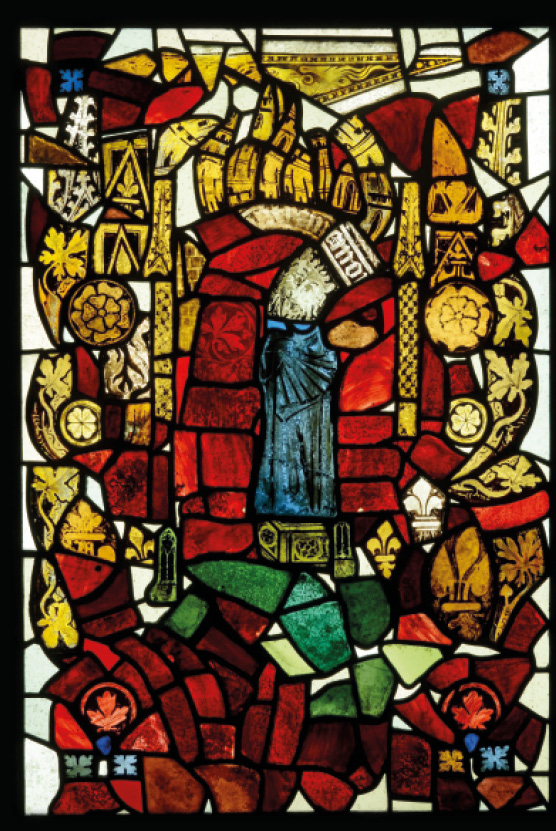
In 1946, 500 fragments of brightly coloured stained glass were removed from the window of St Andrew’s Church, Heckington, to make way for a modern replacement. This was not their first move – the fragments, which are mainly thought to…

This distinctive object, found by a metal-detectorist near Wragby in East Lindsey, Lincolnshire, has been identified as a Roman tumbler-lock slide key. Its handle consists of a sizable, solid, copper-alloy rectangular block with banded collars at the top and bottom…

REVIEW BY LISA BRUNDLE The archaeologist Michael J Jones, having worked for 40 years in Lincoln, provides a unique personal account of archaeological discoveries in the former colonia city of Lindum prior to commercial development. For those of us who…

In CA 419, Chris Catling reported on the history and development of kilns and oast houses used for drying the hops that help to preserve and give flavour to beer. This month, he reports on the buildings associated with the production of the malted grain used primarily in making beer and whisky, but also as an ingredient in a range of foods, from bagels to biscuits, and from vinegar to Ovaltine.