

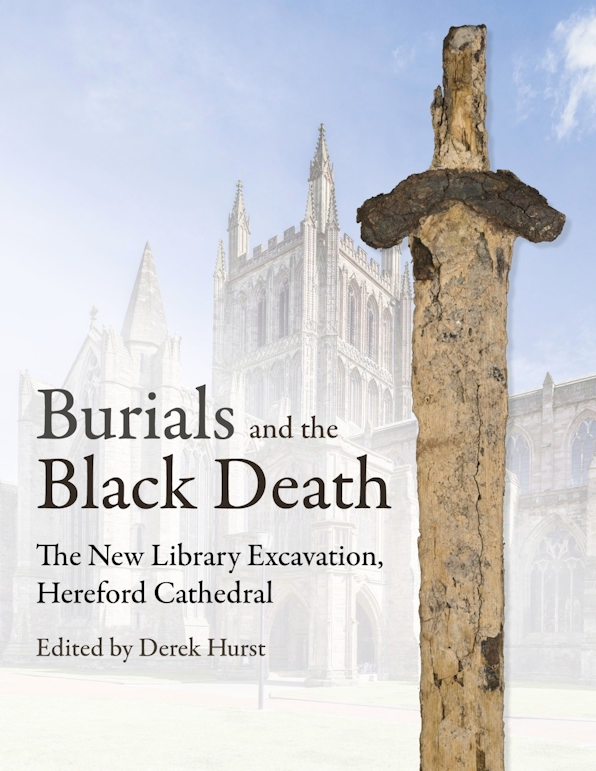
Excavation reports often have a long gestation, and the publication of the City of Hereford Archaeology Unit’s 1993 excavations on the site of Hereford Cathedral’s new Mappa Mundi museum has been eagerly awaited. Yet any frustration at the delay quickly disappears once it becomes clear just how much archaeology this substantial volume has had to accommodate.
Edited by Derek Hurst, Burials and the Black Death runs to an impressive 393 pages and brings together a wide range of specialist contributions. It presents the results of excavations on a site with a complex history, tracing activity from the 9th century through to the post-medieval period. The result is not simply a report on a cemetery excavation, nor solely a study of the Black Death burials highlighted in the title, but a detailed account of centuries of development within the cathedral precinct.
The discussion of the site stratigraphy is thorough, allowing readers to follow the site’s evolution through successive phases of construction, use, demolition, and burial. Particularly fascinating is the discovery of a rare early 11th-century timber building, possibly the bishop’s residence, complete with a stone cellar. The author suggests that this structure may have suffered during the Welsh sack of Hereford in AD 1055, and the subsequent use of the cellar as a convenient rubbish dump further emphasises its diminished status. The Norman rebuilding of the cathedral brought further transformations. A large quarry pit was reused for the deposition of substantial quantities of human charnel, initially disturbed by the cathedral’s rebuilding but supplemented at a later date.


