settlement archaeology

AE157 News 1a

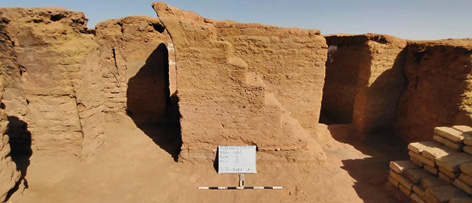
Mit Rahina complex and wine press

A joint Egyptian-Chinese mission documenting the Temple of Sekhmet at Mit Rahina (ancient Memphis) has uncovered the remains of a mud-brick residential complex in the area surrounding the temple. The team also found a limestone wine press (with grape seeds…

AE157 News

Beheira horse burial

The intact burial of a male horse dating to the New Kingdom has been uncovered by an Egyptian team at Tell el-Abqain in Beheira, within a military fortress on Egypt’s western borders. The burial was associated with a large residential…

AE157 News

Necropolis discovery at Kom el-Khilgan

An Egyptian mission excavating at Kom el-Khilgan in Dakahlia Governorate has uncovered an ancient necropolis with evidence of use from the Predynastic Period through to the Graeco-Roman era. The earliest burials appear to be Maadi-Buto culture (c.4000-3500 BC), and are…

AE156 Books

Urban Life and Form in Ancient Egypt

Although there is a rich source of archaeological evidence for towns and cities in ancient Egypt, research into urbanism has, according to Nadine Moeller, often avoided mention of it, because many of the settlements could be regarded as anomalous, not…

Byzantine city plan revealed

An Egyptian mission excavating the Byzantine-era city at Ain el-Sabil in the Dakhla Oasis has uncovered the overall plan of the settlement and several new mud-brick structures. The city was built on a grid pattern with two main streets running…

Screenshot 2026 05 27 at 14.31.00

A strapping find: Halesworth, Suffolk

Strap-ends from belts and other attachments are common finds from the early medieval period. This example was found by Cotswold Archaeology during an excavation in the market town of Halesworth in Suffolk in 2024, with recent conservation revealing its lovely…

An enduring landscape: Uncovering 8,000 years of life and death on the Cotswold Edge

Recent excavations at Milestone Ground on the eastern edge of Broadway have revealed one of the most intriguing archaeological landscapes yet found in Worcestershire. Beneath quiet pasture lay evidence of human activity stretching back 8,000 years, including Mesolithic flint tools, Bronze Age burials, hundreds of Iron Age storage pits, a Roman farmstead, and the largest late Roman cemetery known in the county. Constance Mitchell reports.

Post 1 image0

Early Neolithic Cultural exchange

Archaeological work at Eilsleben, in northern Germany, has uncovered unexpected evidence of connections between the early farmers living at this site and the pre-existing hunter-gatherer communities of the region. Eilsleben was discovered in the 1970s and has since undergone extensive…

Surprising size of Brusselstown Ring revealed

Recent excavations at Brusselstown Ring, a prehistoric hillfort in County Wicklow, Ireland, have confirmed that many of the anomalies found in previous surveys of the site are roundhouse structures. With more than 600 possible examples identified across the hilltop, the…

Unearthing an Anglo-Saxon village in East Anglia

A major excavation, undertaken in advance of the East Anglia TWO and ONE North developments by ScottishPower Renewables, has uncovered 6,000 years of human activity within an East Anglian landscape, including a previously unknown Anglo-Saxon settlement. The initiative represents the…

Fortress of the east

A well-preserved military fortress dating to the New Kingdom has been discovered by an Egyptian team at the site of Tell el-Kharouba, near to the coast in Sinai. Constructed close to the ancient ‘Way of Horus’ military road (connecting Egypt…

A Tiwanaku temple

Research in the Bolivian Andes has identified a previously unknown Tiwanaku ceremonial complex. The Tiwanaku civilisation (c.AD 500-1000) was a pre-Inca culture centred around the southern shores of Lake Titicaca, in western Bolivia, but their influence is believed to have…

Qarn al-Harf: Exploring a Bronze Age refuge

Around 2000 BC, a successful and prosperous Bronze Age culture in Southeast Arabia suddenly collapsed. Traditions and settlements that had developed over centuries disappeared, apart from in one small enclave towards the north of their former territory. Derek Kennet told Matthew Symonds how attempts to hold on to the past ushered in a new era.

Jamestown Archaeology: Remains To Be Seen

REVIEW BY DENNIS B BLANTON This new book from William Kelso is in the tradition of popularised portrayals of archaeological discoveries linked to the ‘Virginia adventure’. Beginning in the 1960s, Ivor Noël Hume published several evocative, book-length accounts of studies…

Neolithic water system in China

Excavations in China have uncovered a set of ceramic pipes that represent the oldest water-drainage system ever found in the country, and appear to have been the product of impressive community efforts. Pingliangtai is a Late Neolithic site in what…

Pithom trade

The ancient East Delta city of Pithom mentioned in the Bible was an important hub for international trade according to new discoveries made at Tell el-Maskhuta (Ismailia Province). The Italian-Egyptian mission excavating there has uncovered a large collection of pottery…