Subscribe now for full access and no adverts
Somerset has been a fertile hunting-ground for Current Archaeology since the magazine’s inception. There is a wealth of archaeological sites and landscapes there, from the uplands of the Mendips to the lowlands of the Levels and many points in between, including some significant urban settlements. In addition, there are strong personal connections that led the founders of Current Archaeology, Andrew and Wendy Selkirk, to visit the county regularly, including with the archaeologists Philip Rahtz (1921-2011); John Coles (1930-2020) and Bryony Coles (born 1946), John’s research partner and later wife; and Mick Aston (1946-2013) – all of whom worked, and in some cases lived, in the county at different times.
To do justice to this rich heritage, I will spread my coverage of the county over two issues. The first half of this double column will focus on central and south Somerset, and is primarily rural; and next month the second half will look to Bath, Bristol, and their environs, and is more urban in focus. Before anyone writes in to complain, yes, I know that this does not stick within the official county boundaries, but I could think of no other way to tell the story of such an extraordinarily rich archaeological area.
The Coleses of the Levels
Telling the story of Current Archaeology’s coverage of Somerset is easy: you begin at the beginning, in CA 1 (March 1967), where the second-ever site visited was that of prehistoric (primarily Bronze Age) Meare Lake Village, near Glastonbury. CA 27 (July 1971) and CA 77 (May 1981) returned there, and this site and these names then set me up neatly for the next step in my Somerset story – that of its wetlands. Covering some 25,000 acres, the archaeology there is inextricably linked to the Coleses. The first overview of these sites came in CA 38 (May 1973) from John and, at that point, Bryony Orme (her maiden name – the pair married in 1985). This feature provides a superb snapshot of both research and practice at this time and place. CA 52 (September 1975) returned with their examination of the Walton Hurdle, a length of Neolithic trackway dating to c.2200 BC, which was discovered, excavated, and lifted prior to the site’s destruction due to peat-cutting.
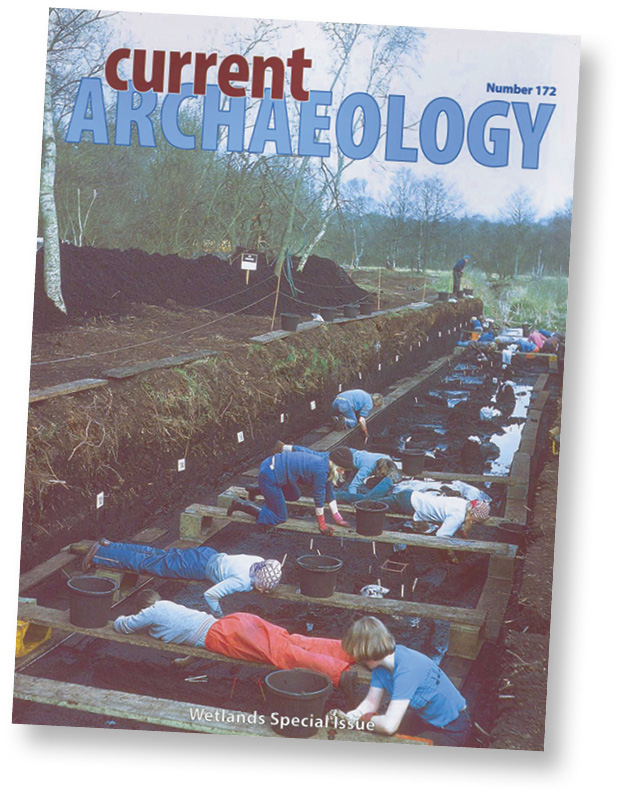
Coles and Orme were next back in CA 84 (October 1982) for a general overview of the Levels, including the first mention in the magazine of the Sweet Track, another Neolithic structure, this one dating to c.3200 BC. Bar occasional snippets of notes and news, the story of the Somerset Levels, at least in the pages of Current Archaeology, then went quiet for a long time, until a magisterial reappearance in the ‘wetlands special’ of CA 172 (February 2001), a survey not just of the Somerset Levels but of wetlands across the UK, published in association with a conference that was being held at the British Academy.
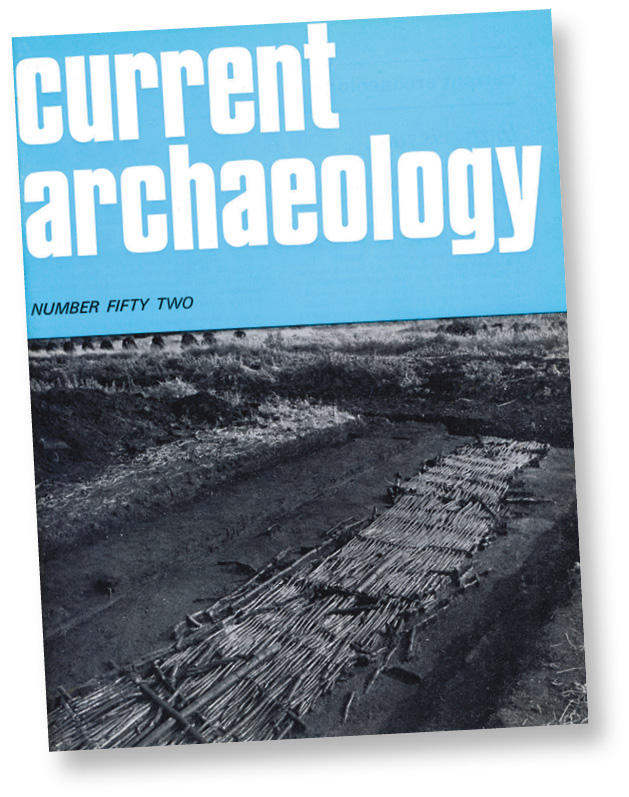
Above & below: Work by the Coleses has featured on at least two covers of Current Archaeology: CA 52, which examined the Walton Hurdle Neolithic trackway, and CA 172, a wetlands special that highlights excavations in the Somerset Levels.
Good King Rahtz
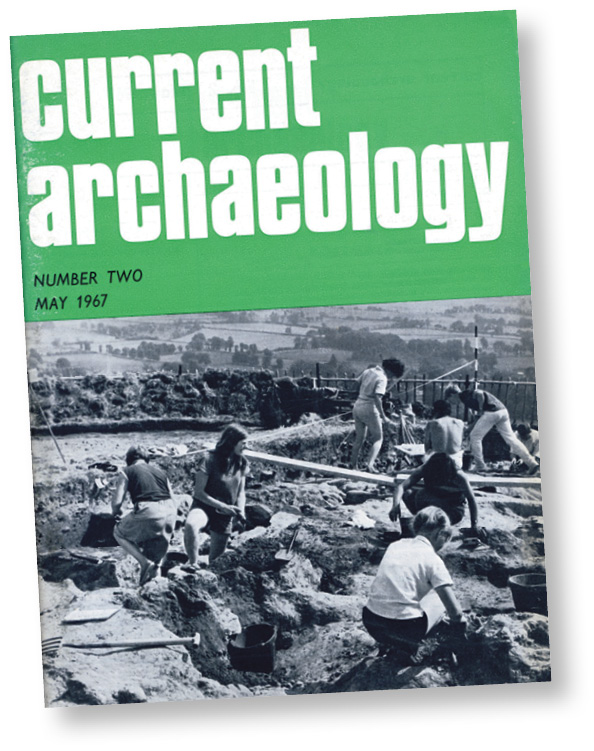
Moving from the lowland wetlands and one famous surname, Current Archaeology’s coverage of the county moves seamlessly to its uplands and another similarly distinguished name. Glastonbury Tor featured in CA 2 (May 1967), when Philip Rahtz was leading excavations there, investigating its early and later medieval history. Rahtz already had a solid archaeological pedigree in the area, thanks in particular to his work in the mid-1950s on the site of what became Chew Valley reservoir to the south of Bristol – a multi-period site that he excavated on behalf of the Ministry of Works. The full story of Rahtz’s life and work, and of his friendship with the Selkirks, is too detailed to go into here, but you can read more from Andrew himself in CA 173 and 258 (April 2001 and September 2011). Returning to Glastonbury, the famous medieval abbey there was examined in detail in CA 320 (November 2016); this is also a good place to flag the examination of nearby Wells Cathedral in CA 73 (August 1980). And returning to Philip Rahtz, we next turn to the site of Congresbury/Cadcong (sometimes also known as Cadbury) in the summer of 1968. Confusingly, at this time two ‘Cadburies’ were under simultaneous excavation in different parts of the county by two different teams, often publishing their results at the same time: this one (the site of a primarily Iron Age hillfort settlement with later medieval occupation just to the north-east of Weston-super-Mare) was examined by a team led by Philip Rahtz and Keith Gardner (see CA 11, November 1968, and CA 23, November 1970); and South Cadbury/‘Camelot’ (an Iron Age and early medieval site north-east of Yeovil) was examined by a team led by Leslie Alcock (see CA 8, May 1968; CA 11, November 1968; and CA 18, January 1970). The latter site’s legendary associations with King Arthur garnered the bulk of attention at this time, unfairly overshadowing Gardner and Rahtz’s exemplary fieldwork at the former, and it is fascinating to compare the approaches to such similar site-types during the same period.