Subscribe now for full access and no adverts
Since March 2020 I have criss-crossed the United Kingdom, examining its history through the eyes of Current Archaeology. I have now visited every county in every country, but I have just a few geographical loose ends to tie off, including, this month, the Channel Islands and the Isle of Man.
Jersey
Jersey has provided the bulk of Current Archaeology’s Channel Islands coverage. It is the most visited of the archipelago’s eight inhabited islands, and has in the Société Jersiaise an active archaeological presence (see ‘Odd Socs’ in CA 339). CA 9 (July 1968) first visited in a mini-special on the island, including arguably the most important site in all the Channel Islands: La Cotte de St Brelade, to which I will return later.
However, it was a site also named after St Brelade that next drew Current Archaeology’s attention, when CA 107 (December 1987) visited the medieval chapel in the bay of the same name on the island’s south-west coast (prehistoric La Cotte de St Brelade is on the opposite headland to the east). This medieval theme continued in CA 137 (February 1994), with a visit to the priory on the islands of Les Écréhous, 10km (6.2 miles) north-east of Jersey, and again in CA 280 (July 2013), exploring St Clement’s priory in the island’s south-eastern corner.
Diving back into the deep past, CA 286 (January 2014) and CA 333 (December 2017) revisited La Cotte de St Brelade, known for its time span of occupation between around 250,000 years ago and after 48,000 years ago, and for its rich array of Palaeolithic materials. Today a coastal cave, the site would have once been a prominent landmark on the plains that linked Jersey to the French mainland.
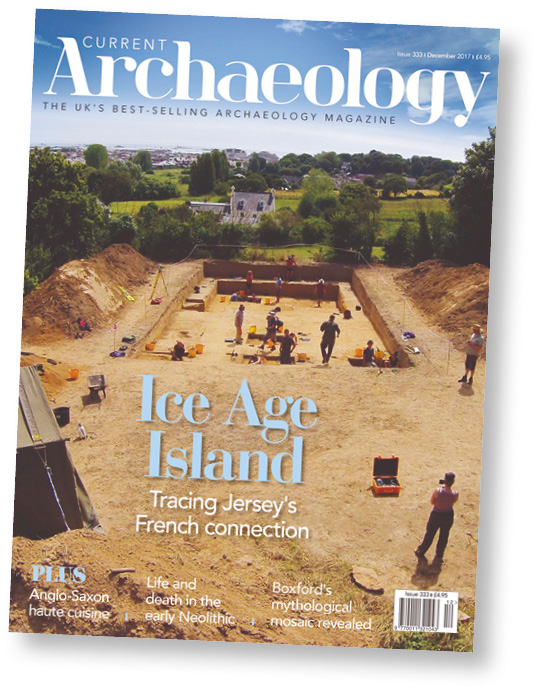
It represents the earliest-known occupation of the Channel Islands, one of the most important prehistoric sites in the UK, and one of the last known Neanderthal sites in north-western Europe.
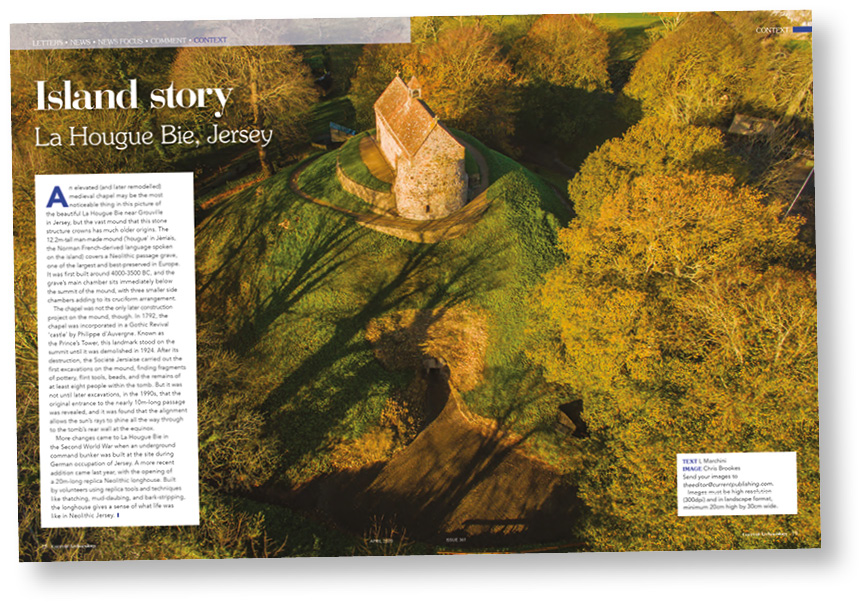
Meanwhile, CA 310 (January 2016), CA 333 (December 2017), and CA 372 (March 2021) visited nearby Les Varines in St Saviour, beyond the eastern edge of the island’s capital St Helier. There has been found art from the Magdalenian era, dating to 15,000 BC – the time of Homo sapiens hunter-gatherers, who reoccupied Europe between 130,000 and 16,000 years ago, as the glaciers retreated at the end of the last Ice Age. However, it is not just extensive prehistory at which Jersey excels. CA 325 (April 2017) and CA 373 (April 2021) reported on the Le Câtillon II hoard, found just south of La Hougue Bie (of which, more in a moment), in the east of the island. It contained some 70,000 Celtic coins, making it the largest hoard yet found in the British Isles. Nearby is the remarkable site of La Hougue Bie, a stunningly well-preserved Neolithic passage grave within a prominent mound surmounted by a medieval chapel (see CA 183, December 2002, and CA 361, April 2020). All these sites are short distances from one another, making for a tour around the island’s archaeology that is as navigable as it is spectacular.
Guernsey
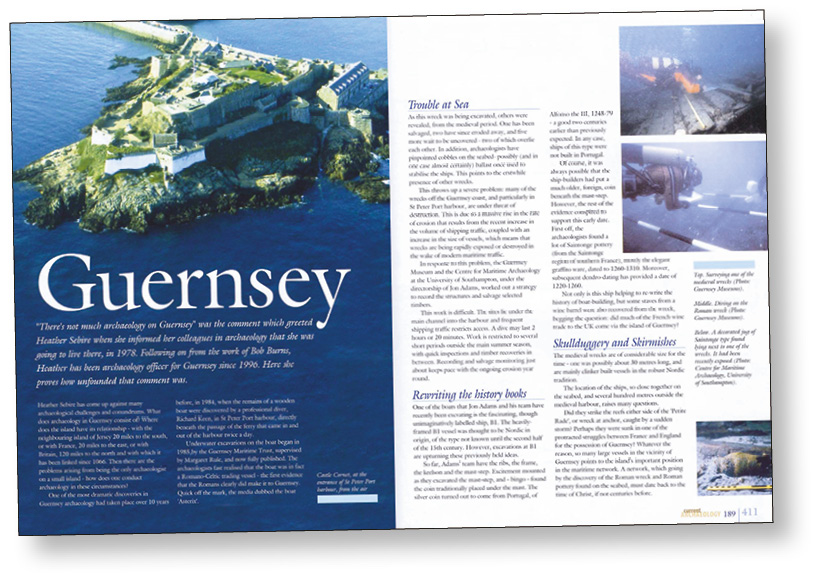
Guernsey has had less coverage in Current Archaeology than Jersey down the years. Its main mention comes in CA 189 (December 2003), which featured a multi-period review by Heather Sebire, the island’s archaeological officer at that time. I was lucky enough to work on one of the sites mentioned there: the series of medieval shipwrecks discovered in the mouth of the harbour capital of St Peter Port. During my stay, we were lodged on nearby Castle Cornet, which also features in Heather’s review – a personal highlight of my fieldwork career. CA 189 also reported from nearby Lihou, a small island just off the west coast of Guernsey with a well-preserved medieval priory as well as some fine Mesolithic remains. Further evidence of the island’s maritime connections then came in CA 333 (December 2017), with a most unusual find – that of a medieval porpoise found in a grave that looked like it had been dug for a human being, uncovered during excavations at the site of a medieval monastic retreat at Chapelle Dom Hue in the island’s south-west. The other big find that has been reported in depth in Current Archaeology is that of a Neolithic galley grave within Delancey Park in the north-east of the island. CA 249 (December 2010) reported on fieldwork there to re-examine a site first explored in the 1920s and 1930s that was subjected to the rigours of a modern-day archaeological survey at this time.
Sark
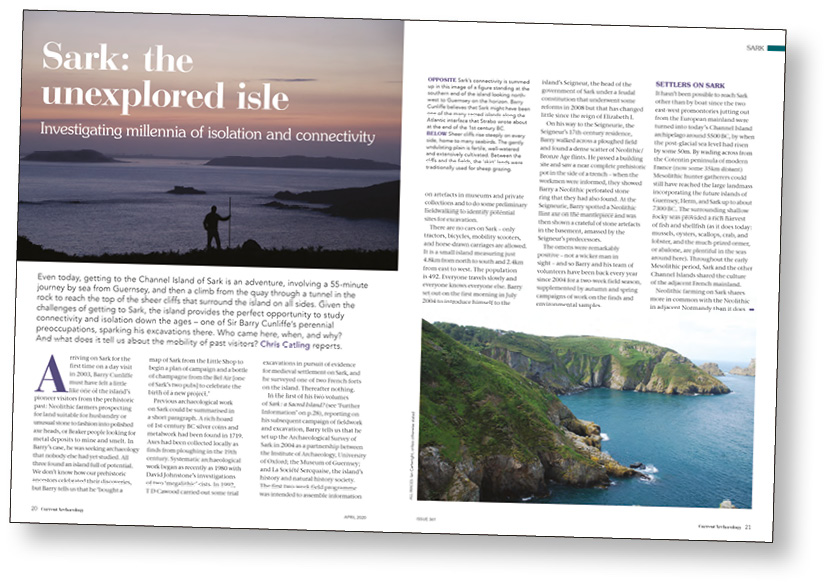
A short sail due east of Guernsey (and forming part of its historic bailiwick) lies the island of Sark, famous for its distinctive system of government based on Norman law, and for its absence of cars – only tractors, bicycles, and horse-drawn vehicles are allowed. In archaeological terms, it is notable for being the first of the Channel Islands ever visited by Current Archaeology, back in CA 8 (May 1968), when a hoard of 1st-century BC metal horse-trappings, together with a cache of later Gaulish coins, was examined. Alas, it then took until CA 361 (April 2020) for the next and most recent visit of note, this time by no lesser person than Sir Barry Cunliffe. His explorations are typically insightful and erudite, studying both the island’s connectivity and isolation across millennia, and I highly recommend this review to you.
Alderney
My final stop on this tour of the Channel Islands is Alderney (also part of the bailiwick of Guernsey), the northernmost island of the archipelago. Current Archaeology’s coverage there is modest, and can be split into two distinctive sections separated by 2,000 years: its Iron Age and Roman occupants – examined in CA 9 (July 1968), CA 261 (December 2011), and CA 401 (August 2023), especially the Roman fort on the north-east coast – and its literal occupation during the Second World War by German forces, including the presence of forced labour workers as well as prisoners at two work camps and two concentration camps. Examined in CA 363 (June 2020), these are now the subject of a formal review by the government, as well as renewed research – see https://occupiedalderney.org. On this sombre note, I sail north-west for the final leg of this archaeological tour of islands: to the Isle of Man.

The Isle of Man
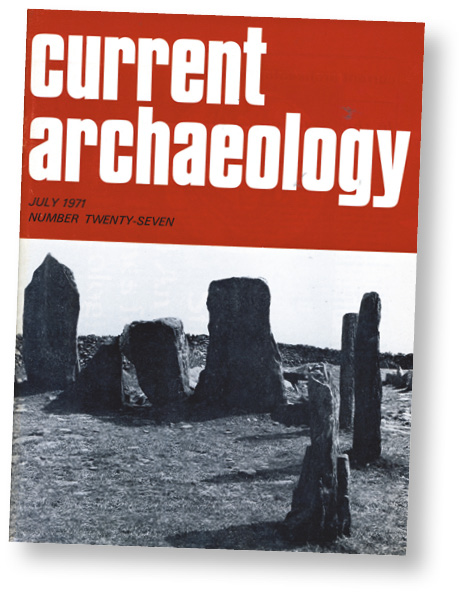
There have been periodic visits by Current Archaeology to the Isle of Man down the years. The first of these came in CA 27 (July 1971) and is the closest to an ‘island special’: a report on the Easter 1971 Prehistoric Society field-trip. Further reports on the island’s prehistory then came in CA 150 (November 1996), concerning a Mesolithic and Neolithic site at Billown in the south of the island; and in CA 235 (October 2009), about a Mesolithic site at nearby Ronaldsway airport. From later prehistory, there are then reports on Bronze Age burial sites in CA 355 (October 2019) and CA 371 (February 2021).
Surprisingly, the island’s later (especially Viking Age) archaeology is rarely covered – an exception is CA 384 (March 2022) on brooches from this era. The only sustained coverage of any site later than this date comes from Peel Castle on the west coast, a multi-period site with 11th-century origins reported on in CA 99 (February 1996) and CA 110 (July 1998). This is one of the most important historical and religious sites in the British Isles (and it is the biggest and most complex heritage site on the Isle of Man); as such, it is under the care of Manx National Heritage. Featuring on the reverse side of the Manx £10 note, Peel Castle is a fitting place to end this report. In the next issue, I will conclude my tour of the British Isles in the heart both of central government and of finance: London.
Discover old issues: Read a selection of the articles discussed by Joe for free online at www.archaeology.co.uk/archive415. They will be available for one month from 5 September. Print subscribers can add digital access to the entire back catalogue of CA for just £12 a year – simply call us on 020 8819 5580 and quote ‘DIGI415’.