


In June 2018, a team of archaeologists led by Laurent Vidal from Inrap set about excavating a hitherto unknown Roman necropolis on Corsica. This burial ground lay at Lamajone, to the south of the ancient and modern town at Aléria, and also several hundred metres from the important Etruscan cemetery at Casabianda, a listed Historical Monument. Inrap’s involvement began with an archaeological evaluation the previous year, carried out ahead of a new development project. These initial soundings encountered several burials in various states of preservation. Their distribution, though, suggested there might be as many as 500-1,200 graves, suggesting a site of some significance. Having pursued a heritage preservation policy for many years, the Regional Archaeology Service of Corsica (SRA) decided the findings merited excavation. Plans were duly put in place for fieldwork over an area of roughly 1ha, matching the footprint of the proposed development.
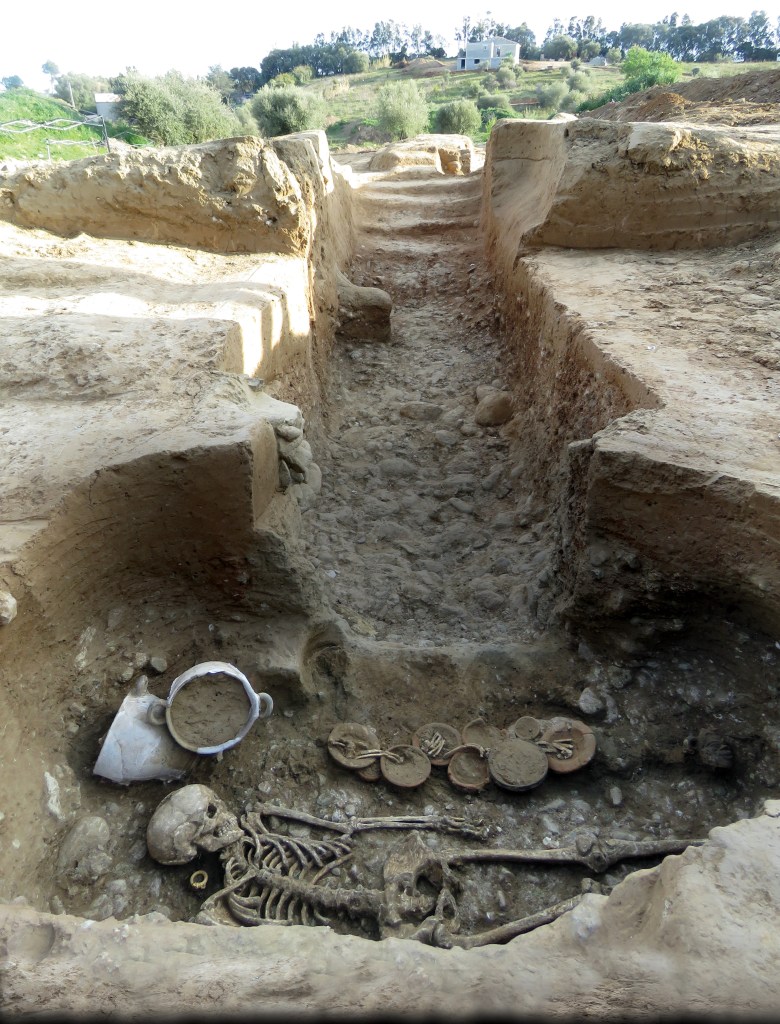
It was while working in the Roman cemetery that Laurent Vidal and his team noticed an enigmatic square discoloration beneath a group of tombs. What they had spotted was no more than a stain in the soil, where a former void had been filled with earth of a reddish hue. Limited investigation of this unprepossessing feature revealed something more enticing: the first steps of a staircase descending into the earth. It led to the greatest archaeological discovery in Corsica for 40 years.

The steps themselves presented a clue concerning what had been discovered. More than four decades earlier, the archaeologist Jean Jehasse had also found steps while working at the nearby Casabianda cemetery. These proved to be the entrance to a hypogeum: a subterranean burial chamber popular among wealthy Etruscans. Now all the signs pointed to the Inrap team having made an equally momentous discovery. Alerted to this development, the SRA decided to upgrade the status of the excavation to one of exceptional importance, bringing both more time to investigate the site and greater resources with which to do it. In collaboration with the SRA, Hervé Petitot – deputy scientific and technical director of Inrap for Corsica – and his team drew up specific research objectives for the discovery. After all, advances in archaeological techniques over the last 40 years meant that the Inrap team could address questions that were barely touched on during the earlier work at Casabianda. Although post-excavation work is currently still under way, fresh insights into Etruscan burial customs are already repaying this care.


Against the flow