
Ain Khadra
Amir Ebrahim Elkorashy explores an archaeological landscape around a spring in the Western Desert.

Amir Ebrahim Elkorashy explores an archaeological landscape around a spring in the Western Desert.

A joint Egyptian-Chinese mission documenting the Temple of Sekhmet at Mit Rahina (ancient Memphis) has uncovered the remains of a mud-brick residential complex in the area surrounding the temple. The team also found a limestone wine press (with grape seeds…
A Roman Period bath complex has been discovered by an Egyptian team working at Tell Nasser in Port Said – the first such structure to be found in the area. The discovery was made during the site’s first excavation season. Cypriot…

An Egyptian mission excavating at Kom el-Khilgan in Dakahlia Governorate has uncovered an ancient necropolis with evidence of use from the Predynastic Period through to the Graeco-Roman era. The earliest burials appear to be Maadi-Buto culture (c.4000-3500 BC), and are…

• An Egyptian mission at the Tell el-Deir site (Damietta Governorate) has uncovered 20 finely carved limestone stela, together with anthropoid pottery coffins, pottery lamps, and funerary amulets. • The hamadryas baboon (Papio hamadryas) and sacred ibis (Threskiornis aethiopicus) may…

A recent series of excavations across Burpham and Wepham in West Sussex has revealed new – and sometimes surprising – insights into their origins and evolution. James Sainsbury reports.

This season’s excavation at Huttons Ambo in North Yorkshire has uncovered new details about the small village’s medieval past, including potentially one of the most high-status buildings yet found on the site. This is the fourth year the project has…

A once-thriving Bronze Age settlement has been revealed during excavations in Erksine, Renfrewshire. The discovery was made by a team from GUARD Archaeology, who excavated two large fields in Northbar, on the south-east outskirts of Erskine, between 2018 and 2019.…

Excavations on the Île de la Cité are uncovering thousands of years of Parisian history. Amy Brunskill spoke to Julien Avinain and Lucie Altenburg to find out more.

This handsome 158-page volume focuses on the Mediterranean and its role in the Bell Beaker phenomenon. Throughout the book, the sea emerges both as an inhabited space and as a medium for communication and circulation. This maritime perspective shifts attention…
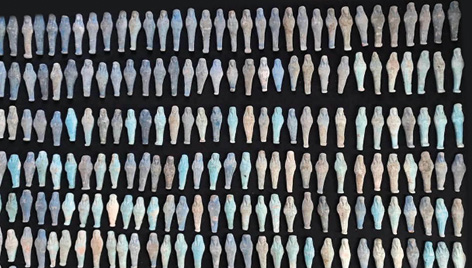
An Egyptian mission has documented an unusual funerary practice in a newly discovered tomb at the Tell Quesna necropolis (Menoufia Governorate), in the central Delta. The team discovered several burials with pottery dishes placed beneath the arms and between the…
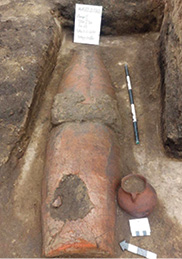
An Egyptian team excavating the multi-period cemetery at Tell Kom Aziza (Beheira) in the Delta has uncovered a section dating to the Graeco-Roman Period with diverse human funerary practices. Burials ranged from simple pits and mud-brick-lined tombs, to decorated gypsum…
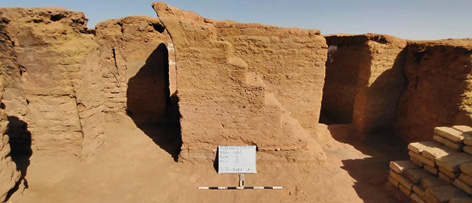
An Egyptian mission excavating the Byzantine-era city at Ain el-Sabil in the Dakhla Oasis has uncovered the overall plan of the settlement and several new mud-brick structures. The city was built on a grid pattern with two main streets running…

A large multi-functional complex dating to the Fifteenth Dynasty (the Hyksos era) has been uncovered by an Egyptian mission at Tell el-Ku’a in Wadi Tumilat (Ismailia Governorate) in the eastern Nile Delta. The team discovered a walled residential compound, measuring…

Archaeology has been ‘solved’! (or, how we shed some light on dark earth…) It was great to see Cotswold Archaeology’s research into the function of burnt mounds included in ‘Sherds’ (CA 435). Chris Catling suggested that we should now turn…

New insights into the Plain of Jars in Laos Xieng Khouang Plateau in northern Laos is dotted with hundreds of ancient stone jars. While they have been the subject of archaeological investigations for over a century, their full use and…

Another prehistoric circle was recently uncovered during a community archaeology project, this time near the Giant’s Ring, just outside Belfast. The investigation, led by archaeologists from Queen’s University Belfast, was sparked by a re-examination of aerial photographs taken in the…

Two recent discoveries – Britain’s largest hoard of Iron Age gold coins and a series of unusual elite burials – unearthed about 8km (5 miles) apart on opposite sides of Chelmsford, have shed vivid light on the area’s Iron Age importance, and how local communities responded to the turbulent period around the Roman conquest. Carly Hilts spoke to Angus Forshaw and visited a new exhibition of some of the finds.

This month sees a return of the Council for British Archaeology’s annual Festival
of Archaeology, with a wealth of in-person and online events taking place across
the UK in July and August. The theme for 2026 is ‘Archaeology and Nature’.
Here is a selection of regional highlights; for more details of each (including
prices and booking information, where relevant), and to explore the full programme, see www.archaeologyuk.org/festival.html.

Archaeological investigations in advance of the A46 Newark Bypass scheme in Nottinghamshire have revealed a landscape scattered with features spanning six millennia. Archaeological Management Solutions (AMS) was contracted on behalf of National Highways to examine more than 23 acres (9.6ha)…

The ways in which archaeologists and historians analyse economies in the past often do not align with how economies are assessed today. Modern economics is primarily based on GDP, which is inherently grounded in monetary values, making it impossible to…

A second season of excavations at Bodiam Castle in Sussex has revealed extensive evidence of a Roman presence, with tiles and pottery confirming that the site was home to a port for the Classis Britannica – the Roman naval fleet…

Community Archaeology reveals 19th-century house A recent community excavation in Belfast has revealed the remains of a 19th-century house and the partial layout of the Victorian streets in the area. Run by Community Archaeology Programme Northern Ireland (CAPNI) – an…

The Outer Hebrides are home to over 170 crannogs (small, human-made islands), some of which are proving to be much earlier in date than suspected. Recently published research centred on Loch Bhorgastail has shed detailed light on the make-up of one such site, and has also pioneered an innovative new approach to documenting its above- and underwater remains. CA reports.

A new synopsis of the history of Nubia is needed given the increase in new research in recent years; Freed’s focus on the art of the region is a refreshing take that rightfully emphasises the unique material produced across Sudanese…

Archaeological investigations in Bearsden, near Glasgow, have revealed evidence of a previously unknown fortlet on the Antonine Wall. This is the 13th Antonine Wall fortlet to have been confidently identified, adding to other examples that were recently revealed during geophysical…

The watering hole found near Gloucester is not the only reworked water source recently discovered in England. Excavations in advance of a new Rolls-Royce extension site at Goodwood, near Chichester in West Sussex, have revealed evidence of a thriving Iron…

Food plays an important role in cultural identity, and can be used in archaeology to identify patterns of migration and assimilation. The early medieval inhabitants of Scandinavia are known to have had a marine-focused diet, but the extent to which…

A group of rock-cut Old Kingdom tombs has been uncovered by an Egyptian mission working at Qubbet el-Hawa, near Aswan. The tombs contained burial chambers that were reused in the First Intermediate Period and the Middle Kingdom. More than 160…

The latest excavation by the long-running Caistor Roman Project has uncovered a series of unusual deposits within the monumental triple ditches that encircled Venta Icenorum, capital of the Iceni. At the same time, recent GPR surveys have shed new light on aspects of the settlement that these once-imposing earthworks surrounded. Giles Emery and Will Bowden report.

My son looked at me askance and muttered ‘more nostalgia’. I smiled, recognising he was right. My Mediterranean journey really began in this unlikely valley and its off-the-beaten-track places that I have dreamed of revisiting. For two full days, my…

The discovery of an extensive and long-lived late Roman agricultural landscape near Cambridge has added illuminating details to our understanding of a region that appears to have been home to numerous villa estates. With the project now published in full, Francis M Morris, who recently completed the post-excavation analysis for Archaeological Research Services Ltd, is our guide to the key findings.

This volume comprises 11 regional or national papers and a synthesis of lipid analysis results. Several contributors note that Impressed Wares have been a ‘Cinderella’ among Neolithic pottery traditions. They echo Isobel Smith’s 1974 characterisation of Peterborough Ware (the Impressed…

Excavations at Harden Quarry, an active hard-rock quarry that is operated by Tarmac at Biddlestone in the Cheviot Hills of Northumberland National Park, has revealed a near complete view of Bronze Age life in this area: where people lived, where…

Workshops from the Late Period and early Ptolemaic era have been discovered by an Egyptian-Italian (University of Padua) team working at the interconnected Kom al-Ahmar and Kom Wasit sites in the Western Delta (Beheira Governorate). The workshops consist of at…

The remains of a complete Byzantine monastic residential complex have been discovered by an Egyptian mission working at the al-Qarya archaeological site, in the Tima district of Sohag. The team found the remains of rectangular mud-brick structures with dimensions ranging…