
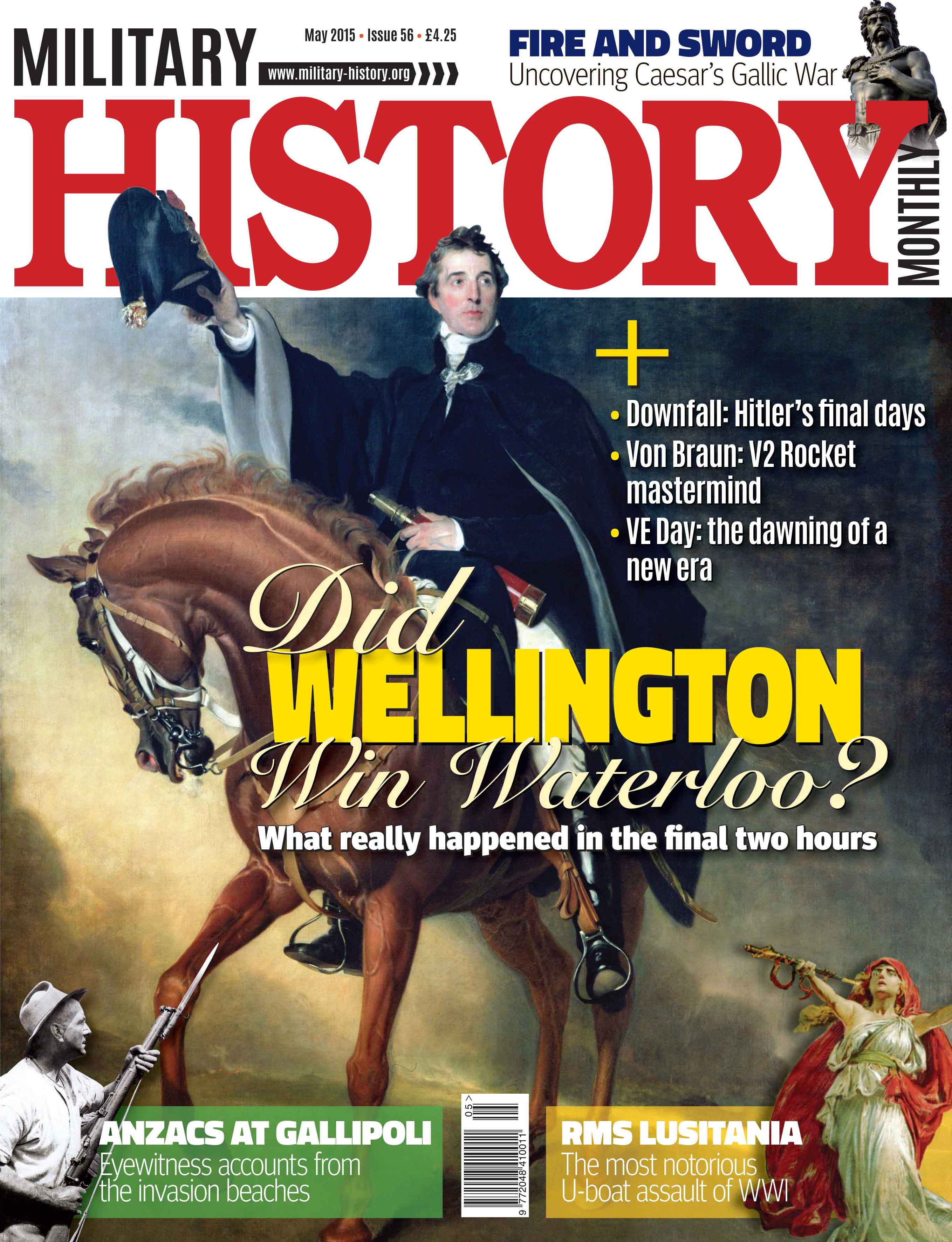
Description
In this issue:
The Battle of Waterloo. To mark the anniversary of the famous clash, MHM takes an in-depth look at the closing stages of the battle with a focus on the final assault of Napoleon’s Imperial Guard. This 18-page extended feature includes:
– Battle Map
– Key to Victory
– The Assault
– Warriors and Weapons
– The Order of Battle
The sinking of the Lusitania – U-boat assault. Stephen Roberts explores the story of the one of the most notorious submarine attacks of WWI.
Gallipoli 1915 – The Anzac experience. MHM describes the first critical hours of the campaign and the futility of the fighting on The Nek. Plus an Anzac eyewitness account of the conditions at Lone Pine.
Fire and sword – The archaeology of Caesar’s Gallic War. Manuel Fernandez-Gotz and Nico Roymans discuss what Roman conquest meant for the defeated.
Plus: news, reviews, museums, opinion columns, and much more!
From the Editor:
The Battle of Waterloo was decided in the final two hours. Two masters of war -masters of very different tactical systems -were pitted against one another. Neither was likely to be outwitted by the other. So it came to a long, hard ‘soldier’s battle’.
Wellington could not risk open manoeuvre with his ragbag army in the face of an enemy that excelled in mobile shock-action. So he clung to the Mont St Jean Ridge, sheltering his men from the French guns in its lee, carefully nursing his line under the hammer-blows of the French columns of attack.
Napoleon had to try to bleed Wellington to death. Waterloo was a battle of attrition, the steady wearing down of physical and moral resilience leaving both armies brittle and ready to snap as afternoon turned to evening.
The climax was the struggle of the French elite, Napoleon’s Imperial Guard, in the final two hours. One half defended the fortified village of Plancenoit against the Prussians. The other half launched a frontal assault on Wellington’s withered line.
Nigel Sale claims that only the independent initiative of the 52nd Light Infantry prevented the Guard from breaking the Anglo-Dutch-Belgian army in two. Paul Dawson insists that the Prussian penetration of the French rear was decisive. Our special this issue explores the arguments.
Also this time, Nico Roymans and Manuel Fernandez-Gotz report on the archaeological evidence for Roman ‘fire and sword’ in Caesar’s conquest of Gaul, Stephen Roberts explores the impact of the sinking of the Lusitania, a hundred years ago this month, and we open three windows on the grim Anzac experience on Gallipoli, also marking the anniversary.
Cover Date: May-2015, Volume 5 Issue 8