
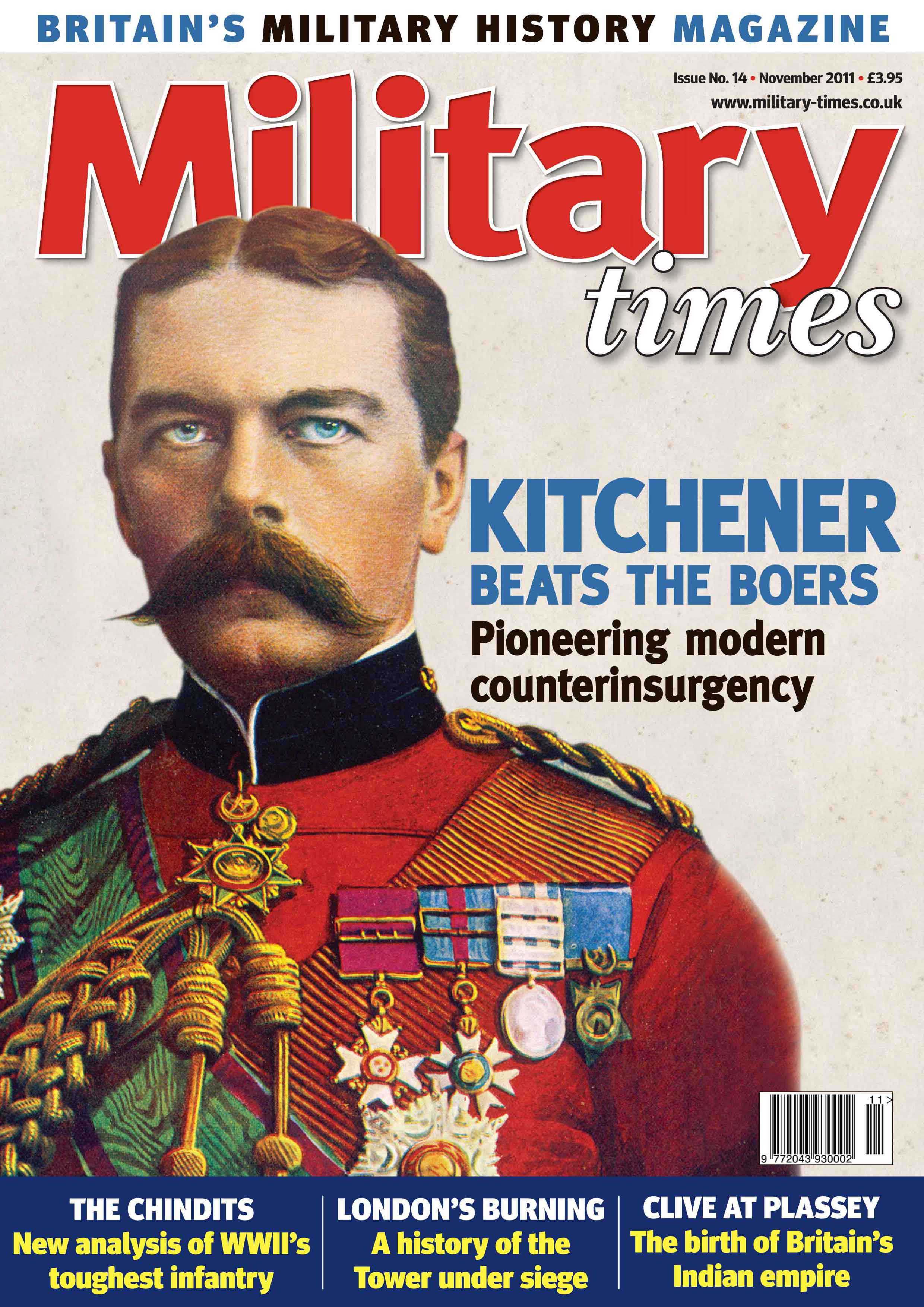
Description
In this issue:
– Boers, blockhouses, and barbed wire -Kitchener’s counterinsurgency war. MHM analyses Herbert Kitchener’s method of counterinsurgency as he faced guerrilla resistance to British rule in South Africa in 1899.
– History of the British Army in 25 Battles -Plassey. For our next instalment of the series, we look at a battle so decisive that its outcome on 23 June 1757 forged the history of Britain, India, and the British Army for two centuries.
– Wingate’s Warriors -The toughest Allied infantry combat of the Second World War. Military historian Tony Redding draws on interviews with 50 veterans of the two Chindit operations in Japanese-occupied Burma to provide a visceral account of the campaigns.
– Huey -How the helicopter determined the outcome of the Vietnam War. Matt Leonard discusses the Huey helicopter’s role in the Vietnam War.
– The Tower Under Siege -A history of one of Britain’s most important buildings. With his new book on the subject published this month, Nigel Jones reveals the Tower of London, not as a tourist attraction, but as a fortress with a long record of medieval siege-warfare.
Plus: news, reviews, museums, opinion columns, and much more!
From the Editor:
Since 1945, most wars have been asymmetrical struggles between conventional armies and guerrilla insurgents. Vietnam rather than Korea has been the model. And it seems clear that the balance of advantage has shifted from the regular to the irregular. The modern guerrilla armed with long-range, rapid-fire, precision weaponry is a far more formidable opponent than predecessors bearing spear or musket.
But modern guerrilla warfare predates the Second World War. It was the method of Irish nationalists in 1919-1921 and Arab tribesmen in 1916-1918. Even earlier, it was the method of South African Boers defending their independence against the British Empire in 1900-1902.
Having been defeated by overwhelming force in conventional operations in the first half of 1900, the Boers dispersed into the rural areas and adopted a guerrilla strategy. In the vast open spaces of the South African veldt, these highly mobile sharpshooters proved themselves exceptional opponents. It took two years and a quarter of a million men to defeat around 25,000 hardcore guerrillas. The architect of victory was Herbert Kitchener.
Our lead feature this issue analyses Kitchener’s pioneering counter-insurgency strategy. What are the lessons? Perhaps the crucial one is this: whatever you do, however clever you are, the advantage is always with a guerrilla fighter embedded in the landscape and lifeways of his homeland. The cost of victory for an invader is always likely to be exceptionally high.
Cover Date: Nov-2011, Volume 2 Issue 2