
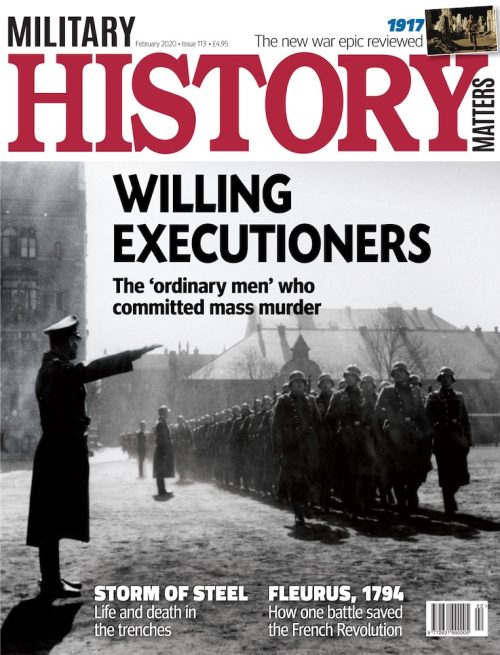
Description
In this issue:
– Willing executioners: the ‘ordinary men’ who committed mass murder
– Storm of steel: life and death in the trenches
– Fleurus, 1794: how one battle saved the French Revolution
– Old weapons, new tricks: the return of the ram
– Sister Janet Wells: the ‘Florence Nightingale’ of the Zulu War
Plus: news, reviews, museums, opinion columns, and much more!
From the Editor:
Our special this issue marks the 75th anniversary of the liberation of Auschwitz-Birkenau extermination camp by Soviet forces in January 1945.
We ask two disturbing questions. First, who was responsible? We base our answer on Christopher Browning’s seminal work Ordinary Men, an academic study that seems to show that a majority of ‘ordinary men’ are capable of mass murder.
Second, why was the camp never bombed? Most of the killing was done late in the war, by which time Allied leaders knew what was happening in the camp, and Allied forces had air superiority over Occupied Europe. Many who perished might have survived if the railway lines and gas chambers had been bombed. Why was it not done?
Also this issue, we have articles on two military innovations – balloons and rams. The Battle of Fleurus in June 1794 – a decisive one for the French Revolution – saw the first use of an observation balloon, and the Battle of Plum Point Bend in May 1862 the reintroduction of the naval ram.
We also mark the release of Sam Mendes’ First World War blockbuster 1917 with the first of a two-part analysis of trench warfare, and conclude with a Sideshow feature reporting on the ‘Florence Nightingale’ of the Anglo-Zulu War of 1879.
Cover Date: Feb-2020, Volume 10 Issue 5