Current World Archaeology 105

Description

Highlights:

From the Editor:
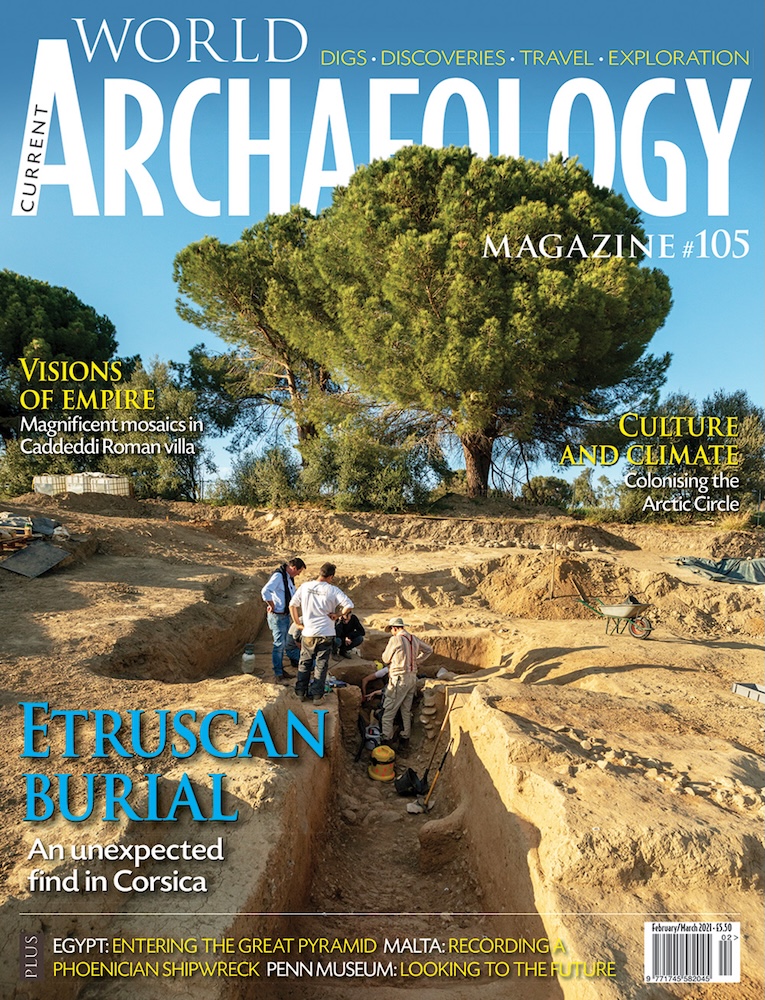
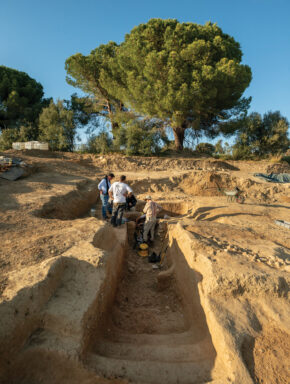
Excavations on Corsica sprang a surprise when archaeologists discovered a set of steps descending into the ground. Work at the site, undertaken in advance of a building development, had already revealed a Roman-era cemetery. The steps, though, led to a much rarer discovery: an intact Etruscan tomb. Within, the deceased lay beside grave goods that reflected her social status and seemingly hold the key to unlocking secrets of Etruscan burial rites.

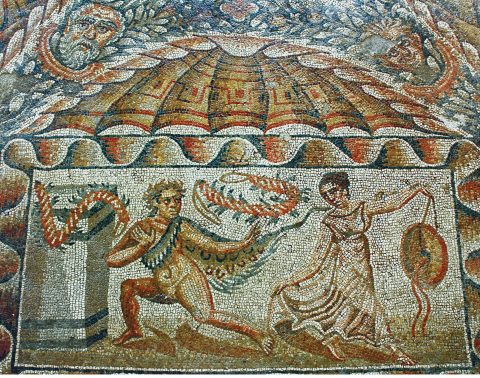
Status was also being flaunted at the Roman villa of Caddeddi, on Sicily. Today, this impressive 4th-century AD residence is little known, but portions of fine mosaics lay preserved inside. These feature scenes ranging from mythology to hunting, while clues in the compositions suggest the owner may have shunned local workshops in favour of mosaicists from North Africa.

Long-distance movements are important, too, for understanding life in the Arctic. Humans have been living in the region for at least 30,000 years, and the passing millennia have frequently forced its inhabitants to adapt to a capricious climate or to make way for incomers bearing advanced technology. Developing ways to travel over long distances allowed Arctic peoples to tap into distant trade routes, including the Silk Road.

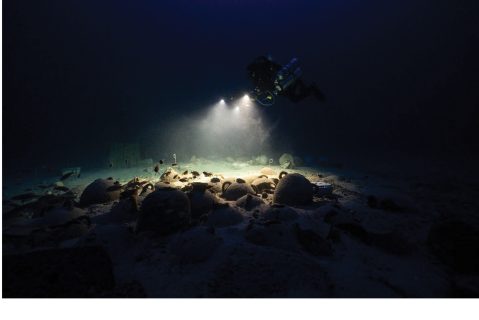
Trade also explains the presence of a wreck off the island of Gozo, in the Mediterranean. The vessel was a Phoenician ship that foundered in the 7th century BC. Archaeological exploration of the site is producing fascinating insights into its cargo, while a new digital museum is making a virtual-reality version of the wreck accessible to all.

Elsewhere in this issue, Richard Hodges casts an eye over how we present the past when he explores the galleries and story of Penn Museum. Finally, we consider the Great Pyramid at Giza and what the monument suggests about the relationship between a pharaonic father and son.


Cover Date: Feb / Mar 2021, Volume 9 Issue 9
Cover Story

An unexpected tomb: Inside an Etruscan hypogeum on Corsica Discovering a previously unsuspected Roman cemetery would normally rank as the archaeological highlight of a building project. Recent work on Corsica, though, revealed an even greater surprise.

Features

Sharing the secrets of a 2,700-year-old Phoenician shipwreck The initial exploration of an ancient Phoenician shipwreck discovered off the Maltese coast was reported on in CWA 88. Now,…
Arctic: culture and climate Humans have been calling the Arctic home for tens of thousands of years. But over the millennia, changes in climate…
Living in luxury in rural Sicily: the late Roman villa of Caddeddi Sicily was famed in antiquity for its agricultural prosperity. An eloquent witness of its late Roman wealth is provided by…

Comment

In praise of volunteers My excavations, including Khok Phanom Di, have yielded well over 1,000 human graves, and often the dead were interred with…
New thinking in scholarship A paper is not necessarily of value because it is heretical, of course; it may just be wrong.
Penn Museum: a museum for the coming decades The symbol of the new Penn Museum is in the refurbished main entrance hall. On a prominent podium behind the…
Preserving and presenting heritage Today, 757 synagogues are deemed to be at risk, which illustrates the scale of the task facing the FJH in…

News

Views

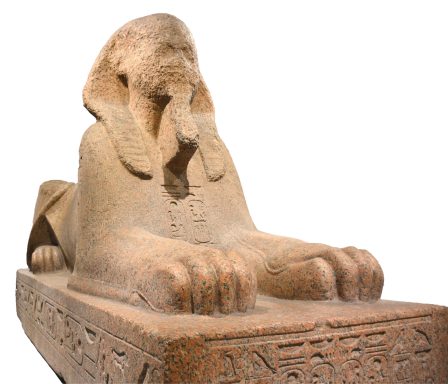
Statue of Ramesses VI What is it? This granite statue depicts Pharaoh Ramesses VI, who reigned 1144-1137 BC. On the back is a hieroglyphic…
The Dancing Satyr of Mazara del Vallo Oliver Gilkes contemplates an ancient masterpiece plucked from the sea.
Penn Museum: a museum for the coming decades The symbol of the new Penn Museum is in the refurbished main entrance hall. On a prominent podium behind the…
The horizon of Khufu: inside the Great Pyramid The sheer scale of Khufu’s Great Pyramid is breathtaking, but there is more to this audacious monument than immediately meets…
A feline find On the strength of stylistic comparisons, researchers have dated the feline to around 200 BC.
Europe without borders The exhibition Iron Age – Europe without Borders is divided into cultural-historical, chronological, and geographical sections. In addition to relics…

Reviews

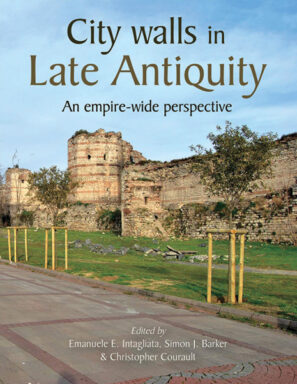
City Walls in Late Antiquity: an empire-wide perspective City walls are the largest structures associated with cities in the Roman Empire, but they seem still to be far…
Digging Deeper: how archaeology works How do archaeologists know where to dig? How do they find out how old things are? And who gets to…
Grave Disturbances: the archaeology of post-depositional interactions with the dead Grave Disturbances focuses on a much-neglected area of funerary archaeology. Disturbed human remains are frequently encountered within burial contexts, but…

By Country

Popular
UK • Italy • Greece • Egypt • Turkey • France

Africa
Botswana • Egypt • Ethiopia • Ghana • Kenya • Libya • Madagascar • Mali • Morocco • Namibia • Somalia • South Africa • Sudan • Tanzania • Tunisia • Zimbabwe

Asia
Iran • Iraq • Israel • Japan • Java • Jordan • Kazakhstan • Kodiak Island • Korea • Kyrgyzstan •
Laos • Lebanon • Malaysia • Mongolia • Oman • Pakistan • Qatar • Russia • Papua New Guinea • Saudi Arabia • Singapore • South Korea • Sumatra • Syria • Thailand • Turkmenistan • UAE • Uzbekistan • Vanuatu • Vietnam • Yemen

Australasia
Australia • Fiji • Micronesia • Polynesia • Tasmania

Europe
Albania • Andorra • Austria • Bulgaria • Croatia • Cyprus • Czech Republic • Denmark • England • Estonia • Finland • France • Germany • Gibraltar • Greece • Holland • Hungary • Iceland • Ireland • Italy • Malta • Norway • Poland • Portugal • Romania • Scotland • Serbia • Slovakia • Slovenia • Spain • Sweden • Switzerland • Turkey • Sicily • UK

South America
Argentina • Belize • Brazil • Chile • Colombia • Easter Island • Mexico • Peru

North America
Canada • Caribbean • Carriacou • Dominican Republic • Greenland • Guatemala • Honduras • USA