
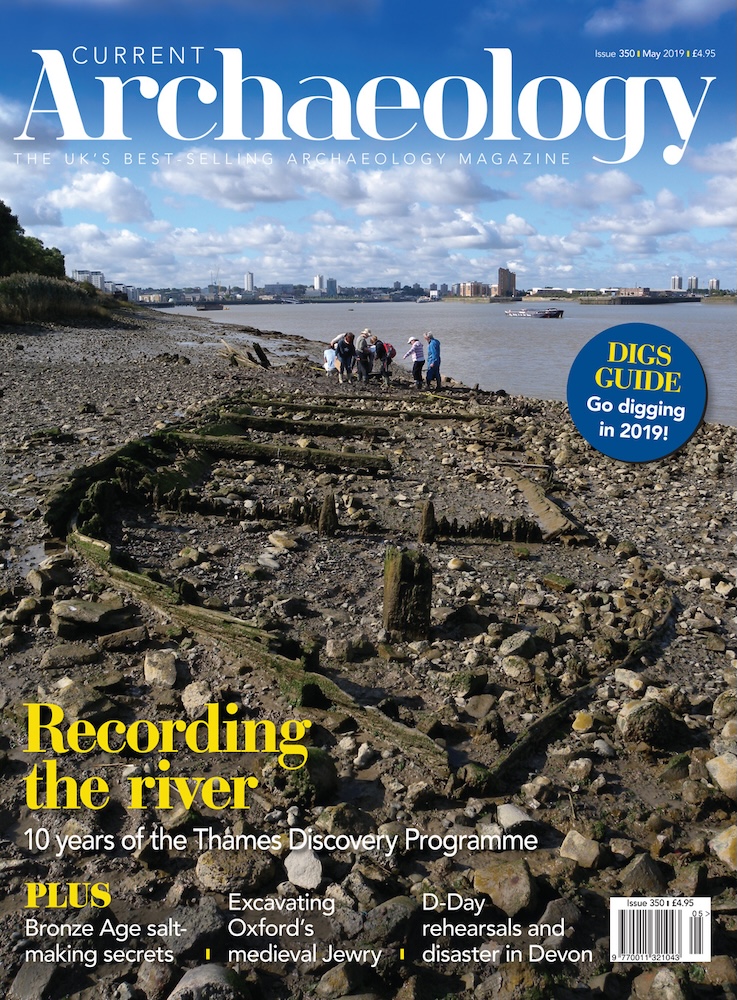
Description
In this issue:
– Recording the river: 10 years of the Thames Discovery Programme
– Bronze Age salt-making secrets: turning seawater into white gold
– You are what you eat? Excavating Oxford’s medieval Jewry
– Exercise Tiger: D-Day rehearsals and disaster in Devon
– Digs Guide 2019: where and how to get involved in archaeology this summer
Plus: News, Reviews, Comment, Sherds, Odd Socs, and more!
From the Editor:
Our cover story takes us to the longest archaeological ‘site’ in Britain: the banks of the River Thames. For ten years, Thames Discovery Programme members have been braving all weathers to record the refuse of centuries of Londoners and newly exposed archaeological features before they are swept away by the tidal river’s ebb and flow.
Amassed rubbish has also proved illuminating in Oxford city centre: there, archaeologists have been poring over 11th-to-15th-century dietary evidence, uncovering tantalising traces of the city’s medieval Jewish quarter.
Speaking of food, salt has long been a key component of many a meal, and its manufacture stretches deep into our past. We visit Lincolnshire to explore some of the region’s Bronze Age salterns.
Our final feature focuses on rather more recent archaeology, taking us to the Devon coast and to preparations for D-Day 75 years ago. The Normandy landings were unprecedented in their scale and complexity, so full-scale rehearsals were planned for April 1944. While this exercise was vital for the operation’s ultimate success, the practice assault ended in disaster, with the loss not only of ships but of hundreds of lives. For years the tragedy was shrouded in secrecy, but recent archaeological work on the wreck site is helping to bring the story of Exercise Tiger to light once more.
Cover Date: May-2019, Volume 30 Issue 2