
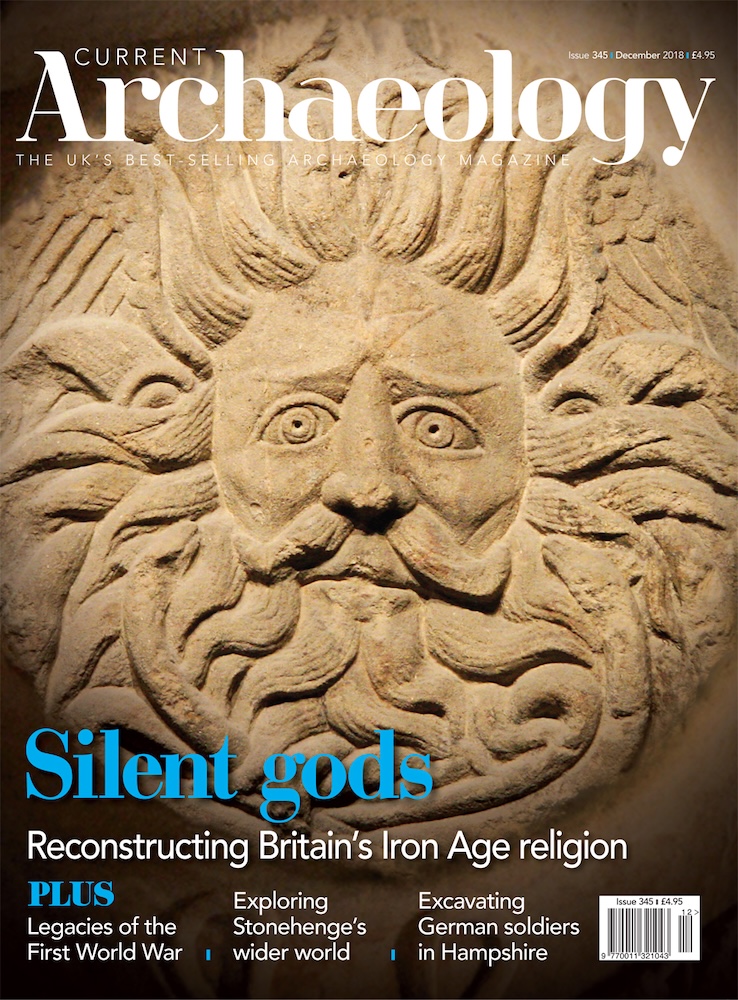
Description
In this issue:
– Silent gods: reconstructing Britain’s Iron Age religion
– Excavating 18th-century German soldiers in Hampshire
– Exploring Stonehenge’s wider prehistoric world
– Uncovering legacies of WWI: buildings, earthworks, airfields, and wrecks
– Moving monoliths: new revelations from the Preseli bluestone quarries
Plus: News, Reviews, Comment, Sherds, Odd Socs, and more!
From the Editor:
This month marks 100 years since the end of the conflict that was supposed to be ‘the war to end all wars’ – sadly, it was anything but. The personal, political, and physical consequences of the First World War have enduring echoes, and although Britain’s landscape was spared the ravages of trench warfare, we can still trace the legacy of this war in our historic environment. Marking the centenary of the Armistice, we explore some of these archaeological clues.
In the mid-18th century, political relationships with our European neighbours were dramatically different. During the Seven Years War, Britain’s ruling powers were so concerned about French invasion that they installed thousands of German soldiers in Hampshire to guard against such threats. Recent excavations outside Winchester have revealed their camp once more.
The feared French invasion never came to pass, but another army that arrived some 1,700 years earlier – the legions of Rome – revolutionised Britain, including its religious practices. Is it possible to trace the Iron Age beliefs that these new rites eclipsed?
Cultural exchanges between Britain and the European mainland ebbed and flowed dramatically throughout prehistory. In the early Neolithic and Bronze Age, these links allowed the flow of both people and influential new ideas across the Channel. Yet during the late Neolithic period, Britain seems to have become more inward-looking, with intriguing artistic results. What can we learn from these contrasting episodes?
Finally, ambitious prehistoric journeys also lie at the heart of this month’s ‘In Focus’, which brings us the latest revelations from the Preseli hills in Wales, thought to have been the home of the Stonehenge bluestones.
Carly Hilts
Cover Date: Dec-2018, Volume 29 Issue 9