


It is an endlessly arresting encounter when your eyes meet a seemingly familiar face, looking out across the millennia. With their life-like colour and unerring gaze, the paintings on thin wooden panels that depicted the dead of Roman-period Egypt have an immediacy to them, seducing us to believe we are seeing the portrait of an individual from antiquity.
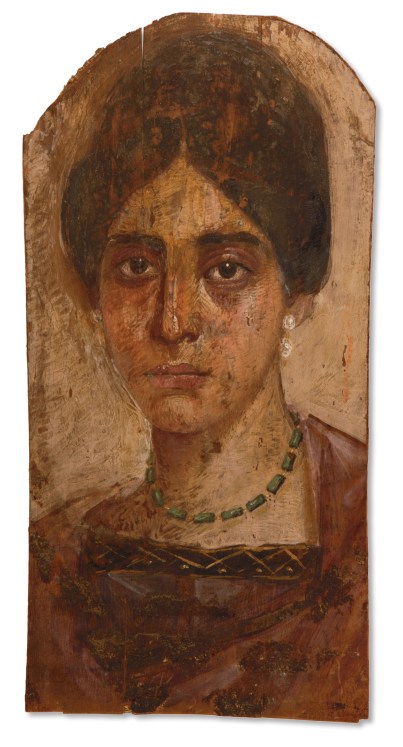
Around 1,000 of these paintings on imported limewood are known, but only about 100 are attached to the mummies of the deceased, where they still cover the face. Most of the images are painted in encaustic, mixing hot wax and pigment, but tempera was also used. Though they are known as Fayum portraits, from the numerous discoveries in the Fayum oasis area, examples have been found across Egypt. The most recent discovery – announced at the end of last year – came from Egyptian archaeologists excavating a large funerary complex in Gerza (Philadelphia) in the Fayum and represents the first new examples uncovered in more than a century. Their use is thought to have started in the Roman period in Egypt, from the end of the 1st century BC, and lasted until the 3rd and 4th centuries AD, with longevity varying in different parts of Egypt.
Egyptologist William Matthew Flinders Petrie excavated many of these paintings more than a century ago. He uncovered his first finds at Hawara in the Fayum, the site of a 12th Dynasty pyramid, in early 1888. Decades later, he wrote, ‘though I came for the pyramid, I soon found a mine of interest in the portraits on the mummies’.


