
The Lexden Lady: Examining a rare lead coffin burial from Roman Colchester

A recently discovered high-status burial offers rare insights into ancient funerary practices and Colchester’s late Roman past. Carly Hilts spoke to Laura Pooley at a new exhibition about the finds.
Start
This article is from Current Archaeology issue 438


Subscribe now for full access and no adverts

Around 1,700 years ago, a funeral took place on the outskirts of Roman Colchester. A young woman had been laid to rest in nested lead and wooden coffins, her hair fashionably styled with gleaming jet pins and her body sprinkled with costly perfumes and preservative substances. An array of food offerings and objects drawn from across Britain, continental Europe, and even further afield were carefully arranged within her grave, highlighting the far-reaching cultural and commercial networks that her family were able to access, and the wealth that they were willing to part with to give her a suitable send-off. 

This was not an isolated grave. The woman had been interred outside the settlement’s walls, in accordance with Roman law, within a large area of burial grounds lining both sides of the main road running west towards London. Previous excavations within this area (today known as the Lexden Cemetery after the modern area of Colchester in which it lies) have revealed hundreds of other graves, and some of their occupants were also clearly of high social status, with discoveries like the finely sculpted Lexden Sphinx (now in Colchester Castle museum) testifying to elaborate funerary monuments. 
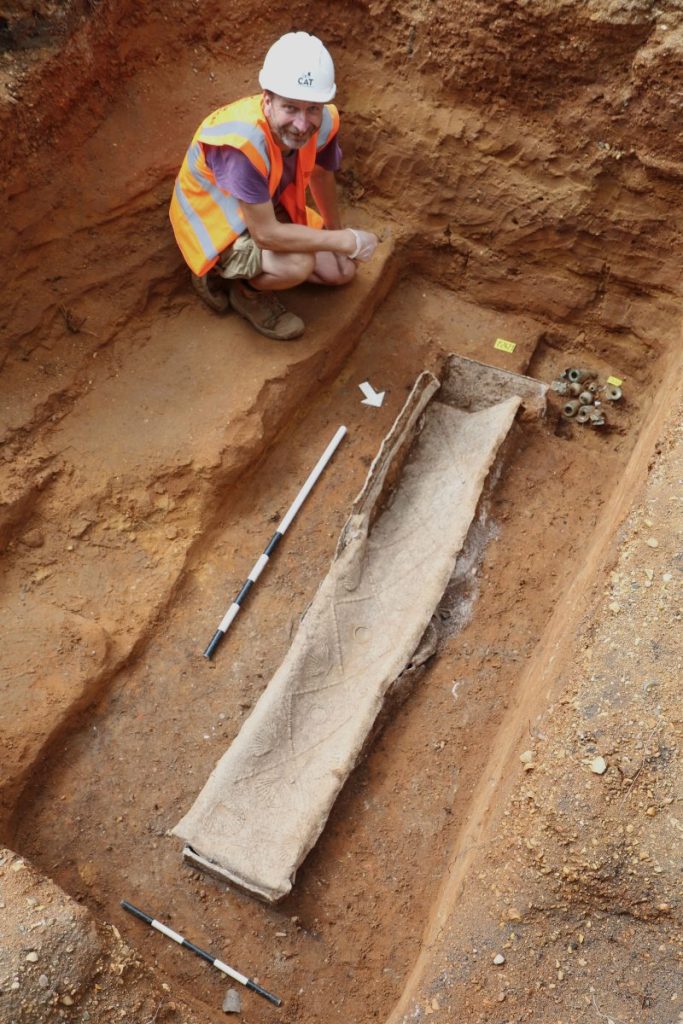
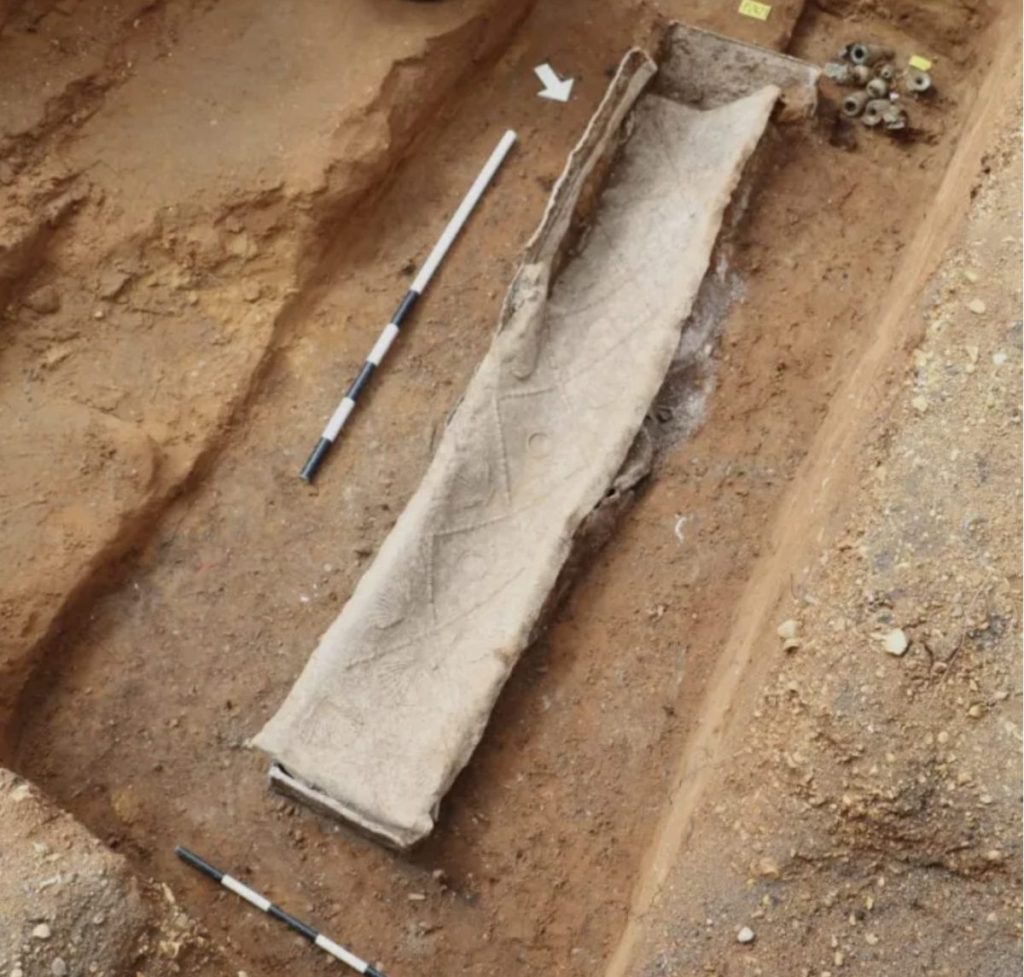
The burial under excavation; a group of rare glass vessels can be seen top right.

As the centuries passed and Colchester evolved and expanded, the cemetery was eventually built over, and in 1820 the area of the young woman’s grave and the Lexden Sphinx became the site of the Essex County Hospital. While the aforementioned sculpture was found during this construction, the woman’s grave lay undetected for another 200 years, until the area was transformed once more. Plans for a new housing development on the now-defunct hospital site prompted excavations by Colchester Archaeological Trust (CAT), and in the summer of 2024 the woman’s burial was brought to light once more. The story of her rediscovery, and what has been learned about her life, is told in a thoughtful new exhibition which recently opened at the Roman Circus Visitor Centre in Colchester (see ‘Further information’ below).

CAT’s investigations uncovered a number of burials on both sides of the Roman road, including a large, rectangular feature which, careful exploration revealed, was a grave containing a decorated lead coffin with a fitted lid. Lead coffins are rare finds in Roman Britain, representing around 2% of excavated inhumations from this period. They were expensive, high status items, though cost seems to have been the only restriction on their use: excavated examples have been found to contain the remains of men, women, and children (including very young babies) alike, and they are associated with both pagan and Christian burial rites. Despite their scarcity, the distribution of lead coffins within Roman Britain is also fairly wide, with documented discoveries of plain examples scattered across south-eastern, south-western, and northern England, and south Wales. Decorated lead coffins appear to have been more concentrated in the south-east, though, particularly around Colchester, London, and Kent. While the example recently excavated by CAT had warped a little during its long period of burial and showed some patches of corrosion, it was impressively intact and well preserved, offering a rare opportunity to examine this distinctive burial rite in detail.
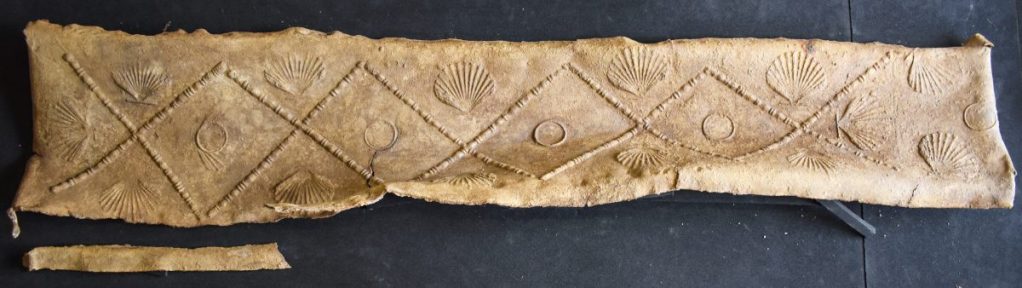
An accidentally superimposed ring and scallop can be seen at the left of the lid.

Intricate designs

Following painstaking excavation over a period of several weeks, the coffin underwent months of careful investigation by CAT, as well as expert conservation by York Archaeology. The presence of iron nails within the grave hints that it was originally nestled inside an outer wooden coffin of which no other trace has survived, but the inner lead casket was essentially complete. Its lid and sides are decorated with a ‘bead and double reel’ design (as well as one triple reel), with decorative lines forming a widely spaced diamond pattern. The gaps within these lines are filled with images of scallop shells (possibly representing the soul’s final journey to the Blessed Isles), as well as circles that might depict the sun or moon.

This attractive object was created using a technique called ‘open sand casting’, in which large wooden frames are filled with fine but compacted damp sand. The desired patterns were then added – probably by pressing a decorative wooden baton into the sand to make the diagonal lines, along with real scallop shells and possibly the rim of a pot – and, when the design was complete, molten lead would have been poured into the frame, spreading to make a large, rectangular sheet that took on the underlying motifs. Once cool but still malleable, this sheet could be cut and folded to create the main body of the coffin, and a similar process would have been followed to make and shape a smaller sheet for the lid. 

The specialist craftworkers, or plumbarii, who made the Lexden example have left us a pleasingly tactile record of their presence: while bending the lead into place, they left their fingerprints behind. Traces like these remind us of the real people behind the production process – and, as I stood beside Laura Pooley (CAT’s Post-excavation Manager and Small Find Specialist, and the curatorial lead for the exhibition), to examine the lid more closely, she described its design as ‘beautifully imperfect’. Although skilfully executed, the pattern as a whole is slightly wonky (even allowing for post burial warping), and in one place Laura pointed out an obvious error: a scallop and a ring superimposed on the same spot – perhaps reflecting someone working in haste to prepare the pattern before the lead was ready to pour. The plumbarii were most likely based in Colchester: lead coffins are extremely heavy – even when empty, an average-sized example weighs as much as two men – so they would probably have been made close to where they were needed. Their raw materials were rather easier to transport, though, and the lead for the Lexden example is thought to have been mined in the Mendip Hills of Somerset.

The sides of the coffin also bore images of scallops and rings.

Personal touches

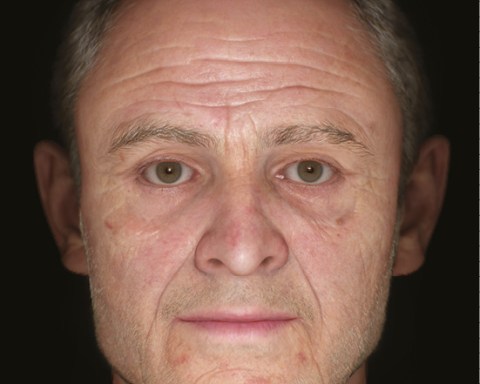
What about the individual – dubbed the ‘Lexden Lady’ by the CAT team – who was laid to rest in such an elegant container? The woman’s skeleton is also present in the exhibition (laid out behind the coffin, to give visitors the choice about how they encounter the human remains; she is carefully covered every evening, Laura said), accompanied by facial reconstructions by medical illustrator Laura Watson, and displays showing the objects that accompanied her to the grave.

Having been shielded from local soil conditions by her lead coffin, the woman’s remains are extremely well-preserved. She had lived for around 25-39 years, and at 5ft 6in tall (168cm), she would have been a little taller than most women of this period (who averaged around 5ft 2in). Her teeth were in good condition, too, and she appears to have enjoyed reasonably good health – at least, her bones show no sign of any traumatic injury or serious infection that could have caused her death – perhaps she succumbed to a short illness. DNA and isotope analyses are currently under way at the Francis Crick Institute in London (see p.22 for more on the work of its Ancient Genomics Lab) and Cardiff University, to learn more about the woman’s ancestry and where she lived at different periods of her life.

Despite the social status suggested by the woman’s coffin, she was not accompanied by lavish jewellery, though a cluster of five black hairpins made of jet from Whitby, far to the north, were found behind her skull, suggesting that her hair might have been arranged in a bun. They were mostly simply designed, with square-shaped tops, though one was more elaborately carved to depict a stylised cantharus (a two-handled drinking vessel). A sixth pin was found outside the coffin, in a corner of the grave where the CAT team also found a group of unusual glass vessels (of which, more below). Its shaft was covered with dents thought to be toothmarks, conjuring a vivid image of its owner or an attendant gripping the pin in her mouth while styling her hair.

While the woman herself was not extravagantly adorned, chemical analysis has revealed a number of expensive additions to the burial. Her skeleton was scattered with a fine, white powder that analysis by the University of Nottingham has identified as gypsum. White substances including chalk, plaster, and gypsum seem to have held a special significance in Roman funerary rites: possibly associated with preservative qualities, they appear in burials across the wider Empire. Ongoing research in York has revealed an apparently very localised practice of pouring gypsum mixed with water over coffined bodies to create a hard coating (CA 436), but the Lexden Lady’s covering of this material is much slighter, suggesting that it was applied in a different way. She had been sprinkled with sweet-smelling (and expensive) resins, too, with analysis by the University of Bristol revealing the presence of frankincense in her coffin.

Five jet hairpins were found behind the woman’s skull, suggesting her hair had been styled in a bun.

Outside the coffin

The objects found outside the woman’s coffin had been just as carefully arranged within her grave cut. They included a smashed greyware jar, positioned level with her right shoulder. Organic residue analysis revealed only low levels of lipid fats on its inner surface, suggesting that it had been relatively new when placed in the grave – perhaps it had been bought specifically for the burial, maybe to hold food offerings, rather than being a reused cooking vessel. Another offering or aspect of a funerary meal might be represented by the headless chicken that had been positioned (possibly on a wooden platter, soil staining suggests) on the other side of the coffin.

These items could have been easily acquired locally, but a collection of rather more exotic objects had been placed in the top left-hand corner of the grave. They were a series of glass vessels whose forms – comprising two funnel-mouthed flasks, two hole-mouthed flasks, and three cylindrical flasks – are rare not just in Roman Britain but in the wider Empire, although parallels are known from what today is northern France and Germany. As well as being interesting in their own right for being so unusual, they provide invaluable dating evidence for the burial, suggesting that it occurred in the late 4th century. This is significant (and surprising, Laura said), as Roman Colchester was thought to have been declining during this period. Clearly, there were still some wealthy people around. A sample taken from one of the flasks, analysed by the University of Bristol, adds to this picture: it contained mastic and balsamic resins that, like the frankincense mentioned above, were extremely valuable materials. 

A scatter of bronze fittings, some with traces of possible leather on their reverse, and tiny fragments of wood, indicate a decorative container for the flasks. Comparisons with better-preserved parallels from Germany suggest this was an ornate box with basketry sides and a wooden lid, possibly covered in leather, on to which eight small decorative domes and one large central one were fixed using iron pins and lead solder. These were interspersed with six metal plates. There were two hinges on one side, and a lock and fastening plate on the other. 

As analysis of this burial continues, it is already offering intriguing insights into late Roman funerary rites – and, while the identity of its occupant has long faded into history, she was clearly cherished by those who buried her in such style and with such care.

Rare glass vessels containing exotic resins had been placed outside the coffin. They suggest that the burial dates to the late 4th century.

Source:

Laura Pooley is Post-Excavation Manager at the Colchester Archaeological Trust. 

Andrea Mobbs is a PhD student at the University of Reading researching Romano-British lead coffins.

Further information: The Lexden Lady: from burial to biography is at the Roman Circus Visitor Centre in Colchester until May 2027; see http://www.catuk.org/roman-lead-coffin-exhibition for more details.

All Images: Colchester Archaeological Trust


By Country

Popular
UKItalyGreeceEgyptTurkeyFrance

Africa
BotswanaEgyptEthiopiaGhanaKenyaLibyaMadagascarMaliMoroccoNamibiaSomaliaSouth AfricaSudanTanzaniaTunisiaZimbabwe

Asia
IranIraqIsraelJapanJavaJordanKazakhstanKodiak IslandKoreaKyrgyzstan
LaosLebanonMalaysiaMongoliaOmanPakistanQatarRussiaPapua New GuineaSaudi ArabiaSingaporeSouth KoreaSumatraSyriaThailandTurkmenistanUAEUzbekistanVanuatuVietnamYemen

Australasia
AustraliaFijiMicronesiaPolynesiaTasmania

Europe
AlbaniaAndorraAustriaBulgariaCroatiaCyprusCzech RepublicDenmarkEnglandEstoniaFinlandFranceGermanyGibraltarGreeceHollandHungaryIcelandIrelandItalyMaltaNorwayPolandPortugalRomaniaScotlandSerbiaSlovakiaSloveniaSpainSwedenSwitzerlandTurkeySicilyUK

South America
ArgentinaBelizeBrazilChileColombiaEaster IslandMexicoPeru

North America
CanadaCaribbeanCarriacouDominican RepublicGreenlandGuatemalaHondurasUSA

Discover more from The Past

Subscribe now to keep reading and get access to the full archive.

Continue reading