Subscribe now for full access and no adverts
Following on from last month’s column on Worcestershire and Warwickshire, I will stay in the West Midlands for this column, moving north into Staffordshire. I have previously explored this region in a ‘run’ of counties visited across 2020 and 2021 – see CA 365 (August 2020) on Shropshire and Herefordshire, CA 368 (November 2020) on Cheshire, CA 369 (December 2020) on Derbyshire, and CA 372 (March 2021) on the West Midlands and Black Country. But there is so much more to offer in terms of the archaeology of this fertile region. Staffordshire has it all, from prehistory to the present day, spread across the pages of Current Archaeology.
Wetlands and moorlands
Staffordshire’s coverage in terms of prehistory begins intriguingly late. The one big surprise to me while researching this column was that the oldest sites featured only date to the Iron Age. If you are an archaeologist of earlier periods at work in the county, here is a chance to remedy this – please do submit an article to the magazine.
The sites in question, however, are superb – there is, to start, an Iron Age farming landscape at Fisherwick near Lichfield in CA 72 (July 1980), and a series of wonderfully preserved Roman sites, including Tollgate Farm near Rocester in CA 253 (April 2011) and Wall, again near Lichfield, in CA 381 and CA 383 (December 2021 and February 2022). The former included an in-filled well within a small industrial complex. Excavated down to a depth of 7m, this provided a wealth of finds of late 2nd- to mid-3rd-century AD date, including several leather shoes. The latter site is the home of a fascinating lead figurine – first unearthed in the 1920s – depicting a man from Sub-Saharan Africa, thought to be part of the grave goods of a 1st-century AD cremation burial. Such finds point to the cosmopolitan nature of Roman Staffordshire, with its excellent connections across Britannia and beyond.
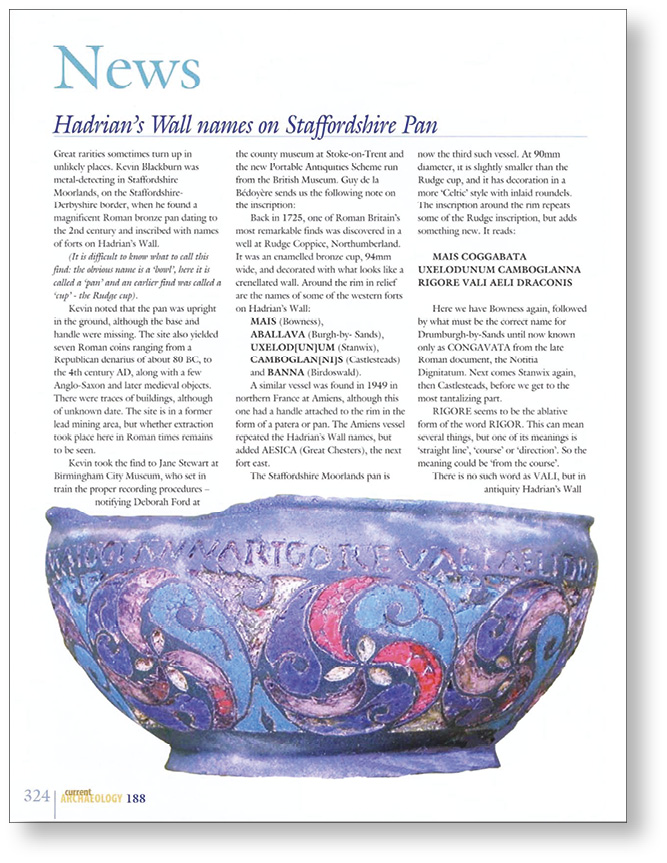
This linkage is further emphasised by the most spectacular Roman find of all from the county: the ‘Moorlands pan’ (sometimes known as the Ilam pan, after the parish where it was found), discovered by a metal-detectorist near the Staffordshire/Derbyshire border in 2003. CA 188 (October 2003) first featured this find, a magnificent bronze dish dating to the 2nd century AD and inscribed with the names of forts along Hadrian’s Wall. It is one of only three such examples known to exist, the first having been discovered in 1725 at Rudge Coppice in Northumberland and the second in 1949 near Amiens in France. The dish – now owned jointly by the Tullie House Museum in Carlisle, the Potteries Museum in Stoke-on-Trent, and London’s British Museum – went on to feature in several other articles in CA down the years, including assessments of Hadrian’s impact on Britain in CA 220 and CA 388 (July 2008 and July 2022), and art-historical analyses of comparable finds of this era in CA 222 (September 2008).
Warriors and farmers
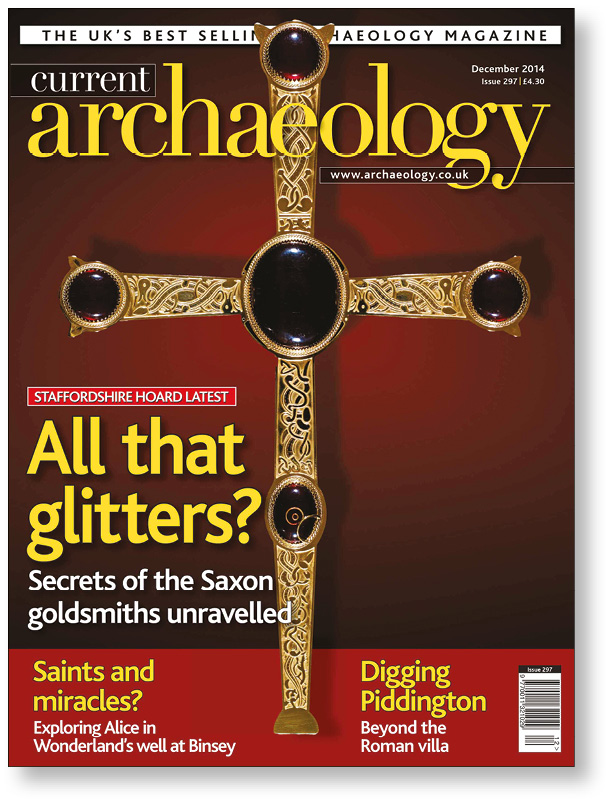
CA 236 (November 2009) featured Staffordshire’s archaeological story of the century: the discovery at Hammerwich, near Lichfield, of the largest hoard of Anglo-Saxon gold and silver ever found. It consists of almost 4,600 items and metal fragments, including 3,500 pieces with garnet cloisonné decoration. The artefacts are nearly all martial in character, and their quality is consistently high. Metal-detectorist Terry Herbert made the discovery in July 2009 while searching an area of recently ploughed farmland, and the find was in due course reported to the Portable Antiquities Scheme, leading to its formal excavation. Subsequently, the hoard was jointly purchased by the Birmingham Museum and Art Gallery and the Potteries Museum & Art Gallery, and it remains on permanent display at the latter in Stoke-on-Trent (see www.staffordshirehoard.org.uk). The story made headlines around the world, and Current Archaeology told the story from beginning to end through a series of articles following on from the initial report, including in CA 276 (March 2013), which updated readers on the latest analyses of the find; CA 290 (May 2014), which examined its likely origin; CA 297 (December 2014), which explored the skills of the craftspeople who produced such extraordinary work; and, most recently, CA 361 (April 2020), which discussed why the hoard was buried.


I would not want readers to think that this is all there is to Saxon Staffordshire, however. There are many other buried treasures in this county. To pick just one example, a then newly-discovered Saxon site at Catholme, near Barton-under-Needwood on the Staffordshire/Derbyshire border, first featured in CA 49 (March 1975) and then again in CA 59 (November 1977). There, some 2.3 hectares (5.6 acres) were excavated between 1973 and 1976, revealing the ground plans of 66 timber buildings. These are thought to represent a series of farmsteads in the area between the 5th and 10th centuries AD, one of the earliest such sites in the Trent Valley. For those of you who are interested, a more recent synthesis of thinking about the origins of the village in England – including mention of this site – appeared in CA 291 (June 2014).