Subscribe now for full access and no adverts
In my explorations of Current Archaeology’s history, I have now visited two-thirds of England and Wales. My plan is to tour the entire length and breadth of the United Kingdom, and now Scotland’s time has come. Comprising a ‘mini-series’, over the next few columns I will visit everywhere from the Lowlands to the Highlands and in-between, including off into the Islands. The sites examined range in date from deep prehistory to the 1970s and, as ever, comprise some well-known locations alongside hidden gems that deserve your attention.
These columns on Scotland are dedicated to the memory of Katharine MacDonald (1976-2022). Kathy was an old friend, an outstanding archaeologist, and a proud Scotswoman. She left us far too soon, and she is deeply missed.
Standing stones and breezy weather
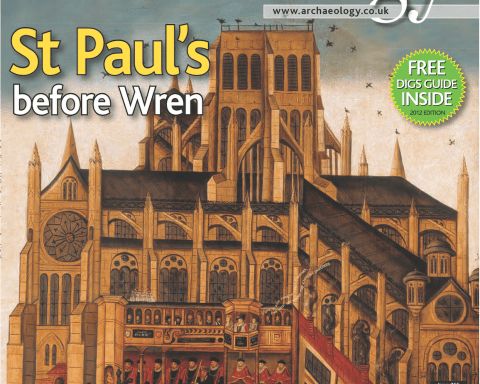
In subsequent columns, I will explore Scotland in depth, moving anti-clockwise from the centre. But it seemed helpful, by way of an introduction, to begin by exploring those national reviews that have previously been undertaken, alongside the examination of a unique ‘site’ that does not fit easily into modern-day geopolitical boundaries: the Antonine Wall. Various partial and full-length ‘special issues’ have cropped up over the years: CA 3 (July 1967) examined early Christian sites in both Scotland and the wider north of Britain, and CA 5 (November 1967) undertook a brief but noteworthy review of active fieldwork under way in the country at this time. It took until CA 34 (September 1972) for a proper, full-length visit by the magazine north of the border, devoted solely to a survey of chambered tombs in Scotland, and timed to coincide with the publication of Audrey Henshall’s magnum opus of the same name.


CA 127 (December 1991) was the first genuinely multi-period survey of Scotland, celebrated with Sueno’s Stone near Forres in Morayshire featuring proudly on the cover. This issue travels widely, from the Neolithic (Loch Olabhat in the Outer Hebrides) to the 18th century (Earl’s Bu in Orkney). Hot on that issue’s heels then came CA 131 (October 1992), with another stunning cover story – that of the Viking boat burial at Scar, Orkney. Again, there is great diversity to enjoy here, from Bronze Age Lairg in Sutherland to medieval Edinburgh. CA 258 (September 2011) was up next, timed to coincide with Scottish Archaeology Month, and the most recent special edition was CA 335 (February 2018), part of a year-long celebration of Scotland’s history and archaeology.
Beyond issue-length reviews, there have also been some notable focused studies of Scottish sites and finds down the years. In chronological order, these include studies of its early historic fortifications (CA 79, October 1981); its National Museum (CA 149, September 1996); the Royal Commission (CA 228, March 2009); its prehistoric henges (CA 270, September 2012); its Iron Age drinking rituals (CA 299, February 2015); and, most recently, its prehistoric origins (CA 385, April 2022).
Life along the maritime superhighway
A different thematic route can be pursued if you consider the maritime and underwater archaeology of Scotland. I will touch on some splendid Viking Age sites in later issues, and the Viking boat burial at Scar, Orkney (mentioned above), would be a rare site anywhere in the British Isles – although see the finds made at Adnamurchan in the Highlands as well (CA 280, July 2013). There are also two excellent surveys of Scotland’s maritime and coastal archaeology, including their Viking connections, in CA 258 (September 2011) and CA 259 (October 2011). It is in this area too, specifically the Sound of Mull near Duart Castle, that a remarkable mid-17th-century shipwreck lies. It is linked to Cromwell’s attempts to suppress the area’s Royalist sympathisers (see CA 197, May 2005, and CA 329, August 2017). See also CA 347 (February 2019) on the 15th- to 16th-century royal dockyard of James IV at Higgins Neuk near Falkirk for another post-medieval maritime community. Finally, it would be remiss of me not to mention work inland, under fresh, not salt, water, at crannogs over the years, including at Buiston in Ayrshire (see CA 127, December 1991) and Loch Tay in Perth and Kinross (see CA 90, January 1984, and CA 362, May 2020). The latter is home to the wonderful Scottish Crannog Centre (https://crannog.co.uk), which I urge everyone to visit.