Subscribe now for full access and no adverts
Northamptonshire offers a delicious slice of English archaeology from prehistory to the present day. Its central location and its fertile soils mean that it has been settled on, fought over, and travelled across for millennia, and Current Archaeology’s coverage over the years reflects this richness.
Prehistoric pictures
CA 49 (September 1975) is an excellent starting point for examining the archaeology of Northamptonshire: it includes one of the magazine’s earliest mentions of the county, along with two of its oldest sites: Hunsbury Hill, a hillfort, and Briar Hill, a causewayed enclosure. Both were being examined at this time, revealing an array of evidence from the Neolithic to Anglo-Saxon eras. CA 58 (September 1977) returned to these locations, where extensive open- area fieldwork was undertaken for eight to nine months of the year for several years in a row, and CA 71 (April 1980) followed up exclusively on the latter site. Delightfully, CA 381 (December 2021) then reported that both places were featured in new displays at the Northampton Museum and Art Gallery, which had been redeveloped at this time in the best traditions of local museums bringing local history to life.
Another good example of this continuity of knowledge then comes from nearby Rainsborough Camp, a hillfort which features twice in the pages of Current Archaeology: first in CA 20 (May 1970) in comparison to similar such prehistoric sites further south in Oxfordshire, and then again 45 years later in CA 301 (April 2015), in comparison to similar sites across the Midlands. This is a textbook example of the best practices in British archaeology – the steady accumulation, and comparison, of knowledge held by local societies, researchers, and curators who understand and love their patch.

Another example of local labour then came in CA 159 (September 1988). There, at Brackmills to the south of Northampton, Anglia Water were installing a new pipeline when they happened upon an Iron Age pit burial (not unexpected in this area) with a torc around the person’s neck (rather more unusual). Further fieldwork revealed a wealth of not only Iron Age but also later Anglo-Saxon burials: 23 inhumations buried west to east – possible indications of an early Christian site.
Friends of the Romans
If there is one ‘great’ site of this county, then the Roman villa at Piddington, south-east of Northampton, has good cause to claim that crown. First featuring in CA 72 (July 1980), updates from there appeared regularly across the 1980s, 1990s, and early 2000s, thanks to the strenuous efforts of the team there, who were led by the extraordinary partnership of Roy and Diana Friendship-Taylor, two of the most influential fieldworkers of this era. The team gradually uncovered the bulk of the villa, unravelling its complex tale of development, decline, and abandonment across the 1st-3rd centuries AD; see especially CA 82 (May 1982), CA 117 (November 1989), CA 146 (January 1996), CA 182 (November 2002), CA 297 (December 2014)), and the most-recent update in CA 356 (November 2019).
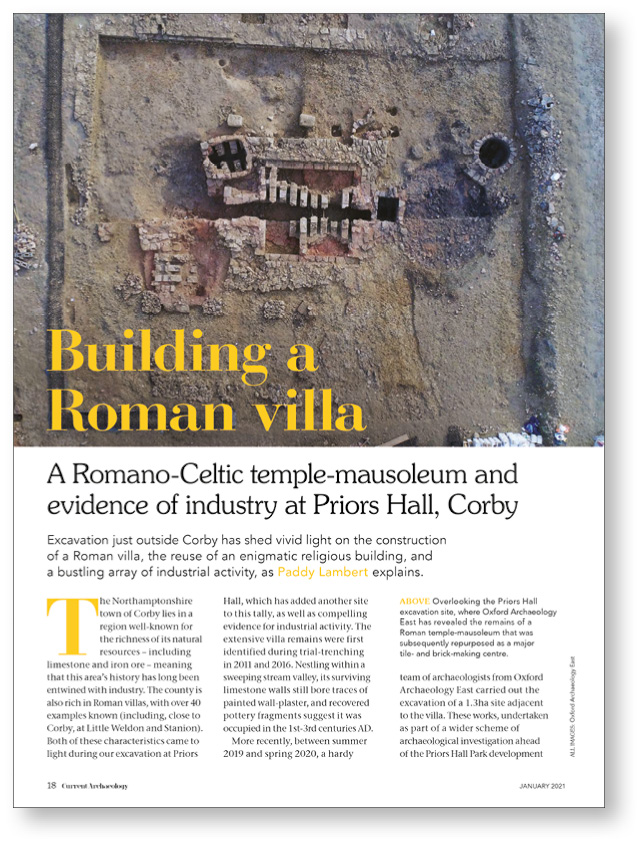
But Northamptonshire’s Roman roads lead to other, lesser-known sites too that are equally worthy of mention. From the two ends of Current Archaeology’s chronological spectrum, for example, CA 9 (July 1968) reported on a Roman bridge identified at Aldwincle near Thrapston, and CA 370 (January 2021) visited Priors Hall near Corby, when a villa, a linked industrial site, and an intriguing Roman-Celtic temple-mausoleum were identified there. [Ed: Watch this space for an update on the latter site in the very near future.]