
Subscribe now for full access and no adverts
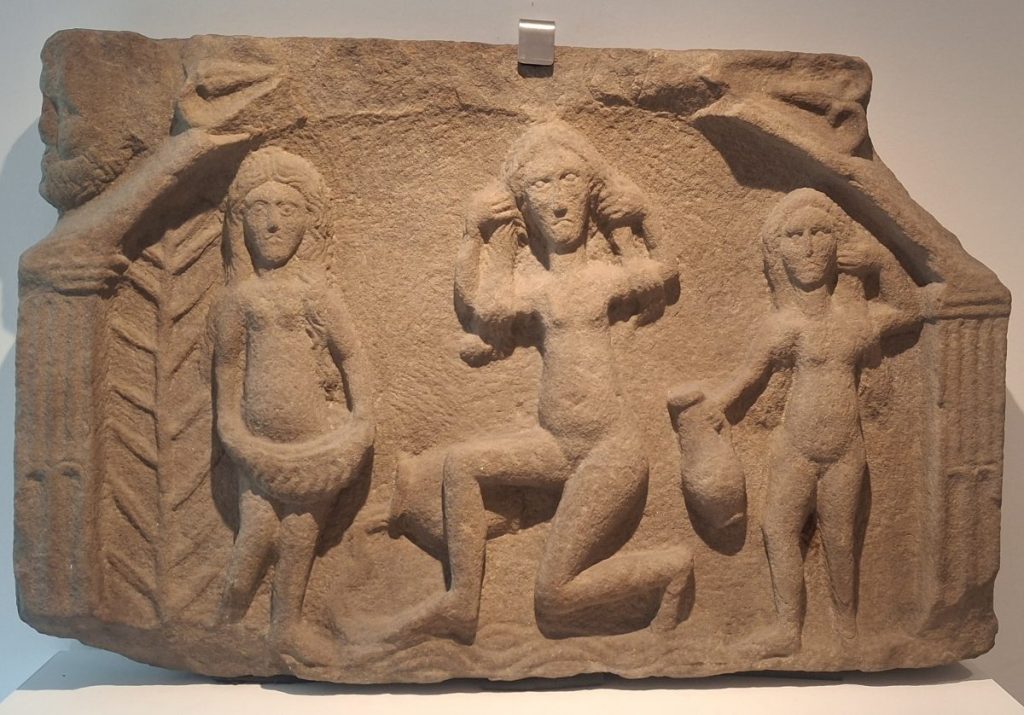
Sixteen miles north of Hadrian’s Wall, excavations at the Roman outpost fort called Bremenium (High Rochester) uncovered a striking sandstone relief. Dating to the 3rd century, it depicts a nude woman crouched in the act of bathing, wringing water from her hair as two attendants look on. To any Roman observer, even on the furthest fringes of Empire, she would have been immediately recognisable as the goddess Venus; while the figure’s starkly geometric lines and confrontational glare have more in common with Iron Age British traditions than the soft curves and naturalistic forms of Classical sculpture, her pose is associated with this specific deity, replicated in more conventional style on finds from Egypt to Rhodes.
The High Rochester Venus appears to have been reimagined according to local tastes; in fact, the goddess has been reinvented by countless cultures over thousands of years. Just as many of the Roman marble statues depicting her are copies of now-lost Greek bronzes, Venus had an earlier incarnation as the goddess Aphrodite. Her origins lie far beyond the realms of Classical myth, however, as an inspiring new exhibition at the Ashmolean Museum in Oxford reveals. Drawing together around 150 artefacts and artworks, including spectacular sculptures, Aphrodite: the making of a goddess traces her story back to Bronze Age Cyprus, c.1200 BC. There, communities worshipped a single, all-powerful deity known simply as ‘the Goddess’, but after large-scale migration from the Aegean brought this figure into the Greek imagination, she was absorbed into their pantheon. No longer the Goddess but one of many, she needed a name to distinguish her from other deities, and ‘Aphrodite’ appears in inscriptions from the 8th century BC onwards. As some of these other goddesses fulfilled roles that had previously been attributed to her, Aphrodite’s sphere of influence also contracted, limiting her key responsibilities to love, sex, and female beauty. Even in this reduced state, though, echoes of her early power can still be found: to the Romans, Venus was also the mother of Aeneas, a Trojan hero whose descendants included Rome’s legendary founders, Romulus and Remus.
The exhibition’s initial displays build a foundation from the familiar, using jewellery, statues (including the celebrated Lely Venus), figurines, coins, pottery, and eclectic other objects to illustrate the main stories associated with Aphrodite/Venus in Greek and Roman mythology. After this, though, visitors plunge into deeper waters, travelling to Cyprus and exploring how the Goddess evolved into the figure that we know today.
This second gallery, the heart of the exhibition, evokes one of the more-than 100 open-air sanctuaries devoted to Aphrodite that are known to have existed in Cyprus between 750 and 300 BC. One side is lined with votive statues referring to the goddess’ many powers, some showing Middle Eastern and Egyptian influences; on the other is an array of ceramic figures reflecting how she was worshipped: dancers, musicians, and women bringing sacrificial animals and food offerings. We then encounter the deity in more familiar guise, represented by breathtakingly life-like marbles – as well as the High Rochester relief and a tiny copper-alloy figurine found at Woodeaton, four miles from the Ashmolean. The exhibition closes with Renaissance rediscovery, when the goddess was revered as the ideal female form, and the ways in which modern culture has embraced and argued against this image. Aphrodite remains an enduring but ever-evolving presence.