Subscribe now for full access and no adverts
We often write in ‘Science Notes’ about how technology is revolutionising many aspects of archaeology, but this column rarely touches on conservation. This is one of the areas, however, where technological advances are having some of the biggest impacts, with conservators now able to preserve materials such as wood (see CA 366 for an example from the Mary Rose) and textiles, feats that were almost impossible a few decades ago. In contrast, ceramics might seem like a more easily conserved material, as they are often one of the best-preserved small finds in archaeological excavations and many examples have remained on display in museums for decades, if not centuries, with little sign of degradation. But, like any curated object, they are sensitive to heat, humidity, and other stressors, particularly those that have been excavated from maritime contexts and have been exposed to centuries or even millennia of salination, waves, and sand erosion. While environmental factors are controlled as much as they can be in a museum setting, there are always developments to be made, such as in the case of recent research published in the Journal of Cultural Heritage (https://doi.org/10.1016/j.culher.2025.09.012). In this study, a team from the University of Koç in Istanbul, Turkey, carried out a pilot study looking at filling in lost or damaged areas of ceramic objects to help stabilise them – often known as ‘loss compensation’ – with a 3D-printed filling that is embedded with sensory equipment, allowing for real-time monitoring of conditions within and surrounding the vessels, with the aim of creating more tailored conservation strategies.
To start, the team selected two maritime amphorae collections on which to focus their research: the Günsenin IV amphorae from the late Byzantine Çamaltı Burnu I shipwreck, which is displayed at the Bandırma Archaeological Museum in Turkey, and another group from the Amalfi coast at the Minori Villa Romana e Antiquarium in Italy. They next created a 3D model of each original object using photogrammetry, taking overlapping photos of the vessel from every angle and then stitching them together to create an accurate digital model. The missing section of each amphora was then isolated and the remaining parts of the vessel removed from the digital version. The segment representing the missing portion was then thickened to correspond with the measurements from the surrounding amphora.
Once an accurate infill had been digitally created, it was then printed. The team recognise that the traditional plastic filaments that are used for 3D printing – polylactic acid (PLA) or acrylonitrile butadiene styrene (ABS) – are not ideal for long-term conservation, as they are easily degraded. Still, for the purposes of this study, they used PLA as they were only trying to show proof of concept. They stress that an important area of future research will be to determine what material might be best for more permanent printed infills.
During printing, the team carefully integrated force-sensitive resistors into the edges of the infill, so that they could monitor any stress it might place on the original artefact. These sensors also trailed into the amphora’s internal cavity, an area that usually cannot be actively monitored in a museum setting, to track temperature, humidity, pH, and stress. The team also found that the 3D-printed PLA infills were able to fit the missing areas so precisely that glue was not necessary to keep them in place.
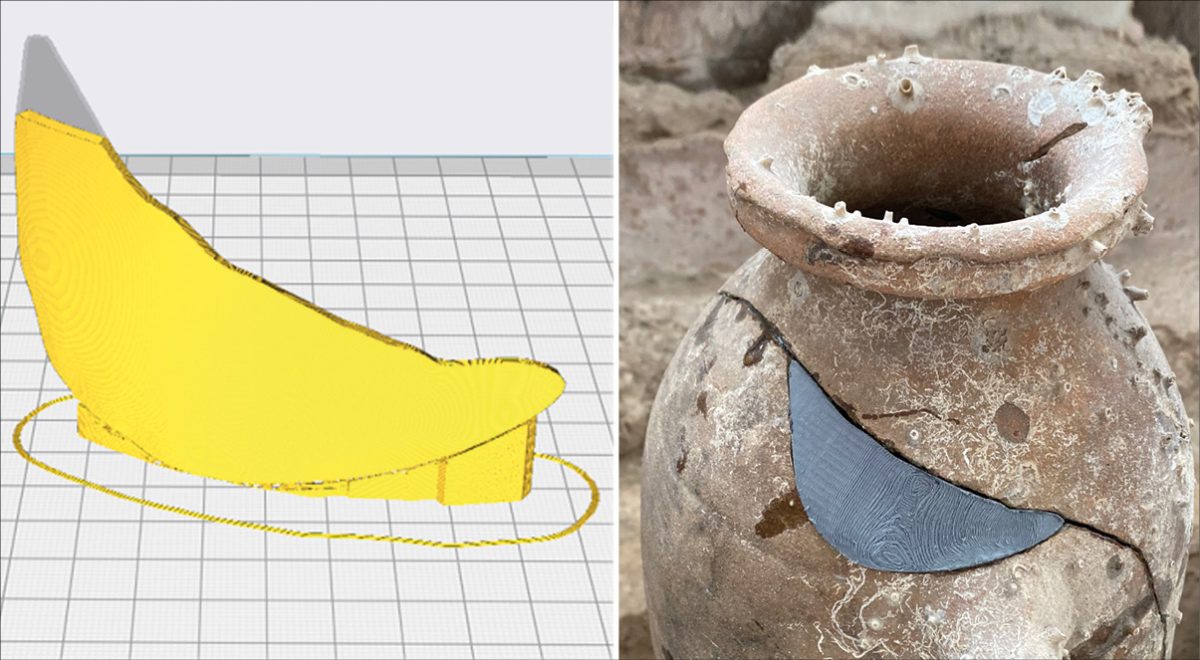
So far, the researchers have created infills for three amphorae: two from the Minori Villa Romana e Antiquarium and one from the Bandırma Archaeological Museum. Preliminary results indicate that the monitors do accurately record the conditions in and around the amphorae, with both temperature and humidity being higher inside the amphorae than in the immediate surrounding environment, as would be expected. So far, the readings have been strikingly stable, suggesting that larger changes would be easily noticeable, and that in future a system could be created to notify conservators if certain parameters are exceeded.
Overall, as the team summarise: ‘Underpinning this approach is the intent that this is a successful first implementation of this 3D printed loss compensation methodology. In principle, this research will provide a baseline application for similar approaches, expanding for use in other artefact types and archaeological contexts.’ An interactive digital model of an amphora with its fill can be found on Sketchfab at https://sketchfab.com/3d-models/929-with-filament-fill-ad720e34eb544bf9a6725e3219ed210e.
Text: Kathryn Krakowka / Image: Bishop et al. (2025) Journal of Cultural Heritage 76