Subscribe now for full access and no adverts
Recent discoveries of exceptionally well-furnished 7th-century female burials – such as those from Trumpington (CA 343) and from Harpole (CA 395) – have drawn increasing attention to a phenomenon associated with the Conversion Period. Isotope analysis of three of these elaborate burials has suggested that these women may have come from the Continent as brides, potentially to strengthen links with leading families in Britain and to help promote the conversion to Christianity. Until recently, this idea was based only on a very small number of burials – but to test whether the pattern holds true for the wider early medieval population, a project entitled ‘Women of the Conversion Period – a Biomolecular Investigation’ was launched, led by researchers from the University of Oxford.
The team initially analysed 86 burials (48 women and 38 men) from six cemeteries, as well as one isolated burial, over half of which were located in Kent, where cross-Channel mobility may have been particularly common. Five individuals were then excluded based on radiocarbon dates which indicated that they probably pre-dated the 7th century. This left a core group of 81 individuals, which were analysed for oxygen and strontium isotopes. By combining these results with previously published isotope data, the researchers were able to compare this core group with a larger dataset of 259 individuals spanning AD 630-800 (131 females and 128 males).
The results were unexpected. First, when compared with isotopic data from the 5th and 6th centuries, more people – both men and women – appear to have been buried in a place further than 10km from where they grew up. This might suggest an increase in non-local marriage alliances during the Conversion Period, perhaps reflecting the growth in trade links at this time. Long-distance mobility (defined as being buried more than 100km from where an individual spent their childhood) also increased for both genders in AD 630-800; moreover, men were slightly more likely to have moved these longer distances than women. The team suggest the reason for this might be multifaceted, including mobility for marriage and warfare, but also the fosterage of boys in different kingdoms.
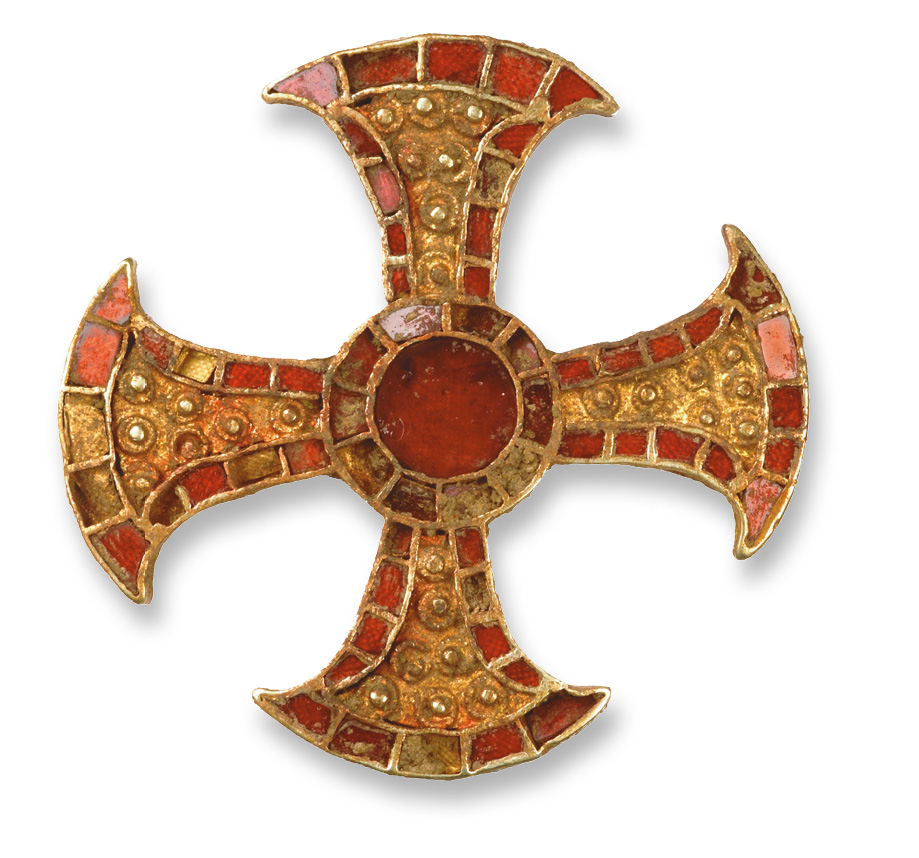
The core group of female burials were then further divided into two: ‘well-furnished’ and poorly furnished or unfurnished burials. To be considered well-furnished, a grave had to meet at least two of the following three criteria: ‘contain one or more objects made of precious metals, a “relic box”, exotic materials such as cowrie shell and amethyst, or a box/casket; be buried under a barrow or in a bed; or contain ten or more grave goods.’ Comparing the two groups also produced surprising results. Contrary to what the results for Trumpington and other burials seem to suggest, the women in well-furnished burials appear to have been far less mobile than their poorly furnished counterparts and more likely to be local to their place of burial. Among the burials with strontium and oxygen signatures indicating a childhood spent in southern and eastern England, 76 per cent belonged to the ‘well-furnished’ group, while among the burials with signatures suggesting origins outside this region, only 45 per cent were well-furnished. In particular, many of the women who were buried more than 100km from where they spent their childhood appear to have come from the ‘Atlantic Fringe’ zone of south-west England, Ireland, and coastal areas of Wales, leaving an intriguing question as to who these ‘non-local’ women were and how they came to live, and die, such a long way from their childhood homes.
The full results of the project were recently published in Antiquity: https:// doi.org/10.15184/aqy.2023.203.
Text: Kathryn Krakowka / Photo: Cambridge Archaeological Unit