Egypt

Heliopolis funerary set

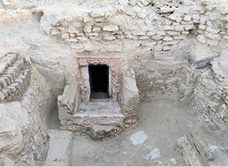
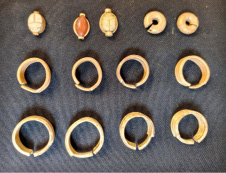
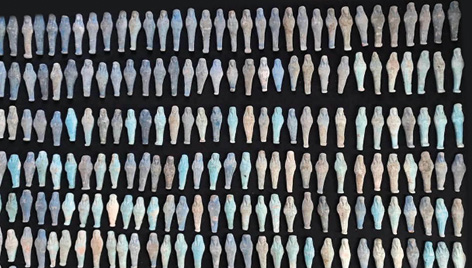
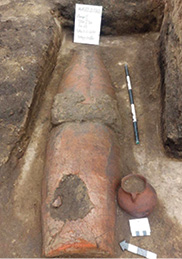
Archaeologists working at ancient Heliopolis (Matariya, Cairo) have uncovered an almost complete funerary assemblage beneath a mud-brick burial structure. The discovery includes a collection of personal and ritual objects, including a copper mirror, alabaster kohl vessels containing traces of cosmetics,…
Tell Quesna burials

An Egyptian mission has documented an unusual funerary practice in a newly discovered tomb at the Tell Quesna necropolis (Menoufia Governorate), in the central Delta. The team discovered several burials with pottery dishes placed beneath the arms and between the…

Tell Kom Aziza cemetery finds

An Egyptian team excavating the multi-period cemetery at Tell Kom Aziza (Beheira) in the Delta has uncovered a section dating to the Graeco-Roman Period with diverse human funerary practices. Burials ranged from simple pits and mud-brick-lined tombs, to decorated gypsum…

Newly discovered Qurna tomb

A Dutch team from Leiden University has discovered a previously unknown Ramesside tomb in Sheikh Abd el-Qurna. Wall inscriptions name the owner as an official called Paser. The tomb has a typical Theban layout, with an open courtyard containing a…

Marina el-Alamein tombs

An Egyptian mission at Marina el-Alamein (the site of the Graeco-Roman city of Leukaspis) has discovered 11 deep rock-cut tombs and 7 limestone surface tombs, many of which are still sealed and well preserved. One of the burials was originally…

Byzantine city plan revealed

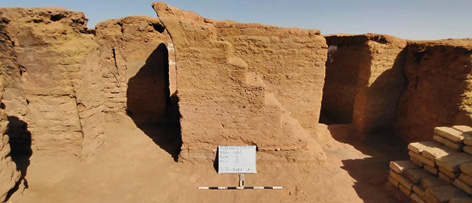
An Egyptian mission excavating the Byzantine-era city at Ain el-Sabil in the Dakhla Oasis has uncovered the overall plan of the settlement and several new mud-brick structures. The city was built on a grid pattern with two main streets running…

Ancient Egypt news in brief

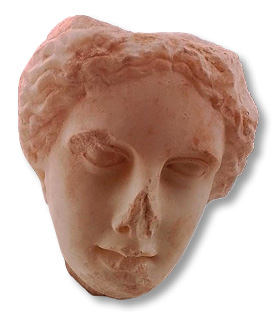
• At Ihnasya (ancient Herakleopolis Magna), an Egyptian team has uncovered the remains of a Roman basilica and a large marble head of the Greek goddess Aphrodite, along with terracotta coin moulds and an inscription of Senusret III (Twelfth Dynasty)…

AE156 News 2a

Hyksos-era complex

A large multi-functional complex dating to the Fifteenth Dynasty (the Hyksos era) has been uncovered by an Egyptian mission at Tell el-Ku’a in Wadi Tumilat (Ismailia Governorate) in the eastern Nile Delta. The team discovered a walled residential compound, measuring…

Cover1000px

Ancient Egypt Magazine 155

• The mineral wealth of Pharaonic Egypt: how geology led to wealth
• Jacques de Morgan, French mining engineer and archaeologist, at Dahshur
• Pain relief in ancient Egypt: plant-based remedies
• The Lost Kingdom of Yam: in search of a mysterious land
• Beyond Montet: new discoveries in the royal necropolis of Tanis
• Bread, beer, and economics: grain for wages and taxes.
• Karl Harris visits Amarna’s Central City and South Tombs

AE155 Yam

In search of the lost Kingdom of Yam

Following in the footsteps of Harkhuf, desert explorer Mahmoud Marai discovers – along with his colleague Mark Borda – an inscription at Gebel Uweinat that sheds light on the whereabouts of the fabled kingdom.

AE155 News 3a

Circular temple at Pelusium

The Egyptian mission excavating in North Sinai at Tell el-Farma – the site of the ancient border fortress of Pelusium – has uncovered a huge circular complex thought to be the remains of a temple to the local god Pelusius.…

AE155 News

Coptic monastery 

The remains of a Coptic monastery have been discovered by an Egyptian mission at Wadi el-Natrun, in Beheira Governorate. The structure, which dates from the 4th to the 6th centuries AD, sheds light on the architectural planning of the first…

AE155 News 5b

Coptic guesthouse

Further north from Wadi el-Natrun, another Egyptian team has found a Coptic guesthouse, dating to the 5th century AD, in the Qalaya area of Hosh Issa (also in Beheira). The building has 13 multi-functional rooms for individual and communal living,…

AE155 News 2a

Gold tongues and Homer

A Spanish mission working at the ancient site of Oxyrhynchus (Bahnasa, in Minya) has found a Roman tomb containing wooden coffins and a number of mummies, three with gold tongues, and one with a tongue of copper. Some of the…

AE155 News 8b

Ramesses re-erected

A colossal statue of Ramesses II has been restored and re-erected in its original position by the Egyptian-American team working at Ashmunein (Hermopolis), in Minya. The limestone statue measures approximately 6.7 metres in height, and weighs over 40 tons. It…

AE155 News 6b

Ramesses III gate and Tiberius stela

A mission from the Egyptian-French Center for the Study of the Karnak Temples (CFEETK) has successfully completed the reconstruction of a Ramesses III gateway in the north-western sector of Karnak. The gate appears to have been built over an earlier…

AE155 News

Mummification compounds

Researchers from the University of Bristol have revealed the chemical constituents of embalming fluids by analysing the air surrounding mummies, rather than removing physical samples. The team captured the gases emitted by the embalming materials of 19 mummies, ranging in…

AE155 News 1a

Urban villa and baths in Alexandria

An Egyptian team working in the northern area of Alexandria has uncovered the remains of a residential villa and circular public baths. The villa, dating to the Roman Period, had mosaic floors in a variety of styles, reflecting the diversity…

AE155 News 10a

Ancient Egypt news in brief

• Egypt, rather than East Africa, may have been the region where the ancestors of modern apes and humans emerged according to researchers, following their discovery of fossil remains of an ape in the Qattara Depression dating back 18 million…

AE155 Books

The Animals of Ancient Egypt: Then and Now

This small-format book is basically a guide is to the wild animals of ancient Egypt. The brief introduction to ancient Egypt’s geography and climate is beautifully written – very concise but almost poetic, a harbinger of what follows. The format…