

In the autumn of 2020, the archaeologist Mike Hodder suggested that I focus a column on CA’s coverage of the Black Country over the years. Mike has spent a wonderful career working across the West Midlands, and he knows its history better than anyone I can think of. The difficulty is, though, where to start and where to end? Before examining CA’s archive, I thought it best to confirm my mental map of the area, only to discover the following comment: ‘the Black Country has no single set of defined boundaries… [and] it is said that “no two Black Country men or women will agree on where it starts or ends”.’ So, for the purposes of this column, I will focus on the metropolitan county of the West Midlands as defined from 1974 onwards: the cites of Birmingham, Coventry, and Wolverhampton, and the boroughs of Dudley, Sandwell, Solihull, and Walsall.
Where Are the Bodies Buried?
It is impossible to consider the archaeology of this area without highlighting its industrial legacy, and CA 112 (December 1988) provides an excellent example of this, exploring Stourbridge’s glass-making heritage, especially its development between 1550 and 1750. But alas, as regards what many would consider the ‘core’ of the Black Country – the boroughs of Dudley, Sandwell, Solihull, and Walsall – there is surprisingly, perhaps shockingly, little reported in Current Archaeology, and the term itself is barely used, with no focused articles, even within a thematic survey of industrial archaeology which featured in CA 216 (March 2008). Dudley does not feature in Current Archaeology; nor Solihull; nor Walsall. Only Sandwell succeeds where the other boroughs fail, thanks in large part to Mike Hodder himself.
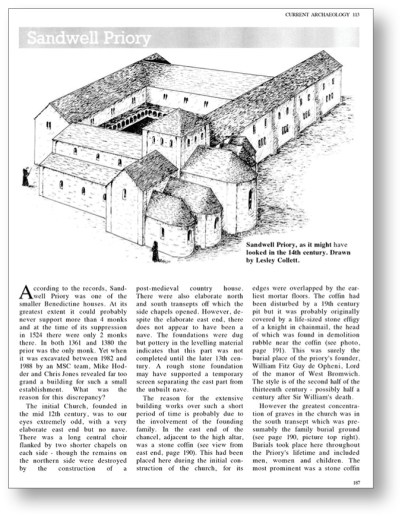
CA 113 (February 1989) visited Mike’s then recently concluded work at Sandwell Priory, a Benedictine House founded in the mid-12th century and unusually dissolved in 1525 – a good decade before the wholesale Dissolution of the Monasteries. The site was excavated between 1982 and 1988 by an MSC (Manpower Services Commission) team led by Mike and his colleague, Chris Jones – a type of project and organisational/funding structure that might be due for a comeback as part of the COVID-19 recovery plan, albeit with a more 2021 title: People Power Services Commission anyone?


